ABIL-Immigration-Updates
FOLLOW ABIL
  • U.S. Blog
  • Global Blog
  • ABIL Home
  • ABIL Lawyers
  • News & Articles
  • More Immigration Blogs
    • ABIL Lawyers' Blogs
    • Immigration Blog Aggregator
  • Contact Us

How Long is a Lawyer Obligated to Correct False Evidence that was Submitted on Behalf of the Client?

6/24/2013

0 Comments

 
by Cyrus D. Mehta, ABIL Lawyer
The Insightful Immigration Blog

One of the cardinal ethical rules governing a lawyer’s conduct is the prohibition, with some exception, from revealing a client’s confidential information. This information, which must be kept confidential, is normally gained during the course of the representation of the client. Still, at the same time, a lawyer is also prohibited from offering or using evidence before a tribunal that the lawyer knows to be false.  If a lawyer gets to know about the submission of false evidence to the tribunal, the lawyer is required to take reasonable remedial measures, and in some states, when the lawyer is unsuccessful in obtaining the client’s cooperation to remedy the fraud, the lawyer is also required to inform the tribunal. ABA Model Rule 1.6 governs a lawyer’s duty of confidentiality while ABA Model rule 3.3 governs a lawyer’s duty of candor to the tribunal. These two rules are often in tension.

The modern trend in legal ethics is that the lawyer’s duty of candor to the tribunal will almost always trump his or her duty of confidentiality to the client. This is especially true in New York. New York’s Rule 3.3 not only prohibits a lawyer from offering evidence that he or she knows to be false, but requires a lawyer to take reasonable remedial measures, including, if necessary, disclosure to the tribunal. The proper course, when the lawyer learns that false evidence has been submitted, is to first remonstrate with a client confidentially, and seek the client's cooperation with respect to the withdrawal or correction of the false statement. Most clients will likely understand that taking such a measure is also in their best interests, and that a lawyer is likely to take steps that are least damaging to the client. For instance, if an asylum claim otherwise includes truthful elements but some false information or evidence, the withdrawal of the damaging evidence may be presented at the same time as part of a packet of evidence that is otherwise truthful and supportive of the client's claim. If the client is uncooperative and withdrawal from the representation cannot remedy the false statement, the lawyer, under Rule 3.3(b), must make disclosure to the tribunal as is reasonably necessary to remedy the situation, even if such disclosure is protected under the attorney client rule of confidentiality.

Prior to April 1, 2009, New York did not require a lawyer to reveal a client’s submission of false evidence to a tribunal if it was protected as confidential information between an attorney and the client, but all that changed when New York adopted Model Rule 3.3. After this sea change in New York, I wrote from an immigration lawyer’s perspective, What Remedial Measures Can A Lawyer Take To Correct False Statements Under New York’s Ethical Rules? When writing the article I puzzled on how long does the lawyer’s obligation to correct a client’s false statement last. Does it last till the completion of the case or forever?  Unlike Comment 13 to ABA Model Rule 3.3, which clearly suggested that the obligation lasts till the conclusion of the proceeding, there is no similar comment to New York’s Rule 3.3.

This has now been answered in New York City Bar’s Formal Opinion 2013-2.  Recognizing that the New York rule does not contain a similar limiting comment like the ABA Model Rule, the New York City Bar concludes that the lawyer’s obligation to correct the presentation of false evidence survives the conclusion of proceedings. However, agreeing with opinions of its sister NY State Bar (see State 831, fn 4 and State 837), the NYC Bar opinion states that this obligation does not last forever, and “should end when a reasonable ‘remedial’ measure is no longer available.” Still, a lawyer is required to take remedial measures even after the conclusion of the proceeding if the tribunal in question, or a reviewing tribunal,  is still in a position to review the new evidence, which in turn could result in an amendment, modification or vacatur of the prior judgment.  Action that cannot result or is highly unlikely to result in such a reversal or modification of the judgment cannot be said to be “remedial,” and then the obligation of the lawyer under Rule 3.3 may end. The opinion also cautions, “The amount of work involved in fulfilling the 3.3 obligation should neither force the lawyer into insolvency or jeopardize the lawyer’s ability to continue to diligently and competently perform legal services on behalf of the lawyer’s other clients [citations omitted].”

How does the lawyer’s continuing obligation even after the conclusion of the case to take remedial measures under Rule 3.3 work in immigration practice?  The term “tribunal” is broadly defined in Rule 1.0(w) to encompass not just a court but even an “administrative agency or other body acting in an adjudicative capacity.” But the definition of “tribunal," and its reference in Rule 3.3, as well as in the NYC Bar opinion, with respect to an administrative agency still connotes a court-like adversarial proceeding involving two parties and opposing counsel. At issue is whether the United States Citizenship and Immigration Services, along with the Department of Labor and Department of State, would be considered “tribunals” under this definition. The definition of tribunal goes on to state: “A legislative body, administrative agency or other body acts in an adjudicative capacity when a neutral official, after the presentation of evidence or legal argument by a party or parties, will render a legal judgment directly affecting the party’s interests in a particular matter.” There is no question that a proceeding before an Immigration Judge or the Board of Immigration Appeals,  would be before a “tribunal,” but there is ambiguity as to whether it would extend to the above governmental agencies too as it is unclear whether there is a neutral official who will render a legal judgment "after the presentation of evidence or legal argument by a party or parties" when one files an application with the USCIS or with a U.S. Consulate.  There is also no opposing counsel in such instances. It is thus arguable whether such agencies constitute a “tribunal,” and whether the 3.3 obligation exists regarding the need to take reasonable remedial measures to correct a client’s false statement or submission of false evidence, even after the case has been completed.

As a practical matter, though, whether an immigration-related agency is a tribunal or not should not matter. If an attorney knowingly assists a client in filing a false application, such conduct may trigger criminal liability regardless of whether the application was made to a tribunal or not. An attorney is also required to be truthful to third persons, governmental or otherwise, under Rule 4.1. Moreover, Rule 1.6(b)(3), while not mandating it, allows a lawyer to withdraw a written or oral opinion or representation relied upon by a third person (even if not with a tribunal), where the lawyer belatedly learns of its falsity. In such a situation, as confirmed by NY State Opinion 837, a noisy withdrawal may constitute a reasonable remedial measure under Rule 3.3.  Finally, a similar duty of candor applies to immigration agencies under parallel ethical rules in 8 C.F.R. §1003.102(c) and 8 C.F.R. 292.3(b), governing the conduct of private immigration attorneys, although the requirement is to “take appropriate remedial measures” without a specific requirement to disclose to the tribunal.

Regardless of the ambiguity in the definition of tribunal with respect to immigration agencies, it behooves a lawyer to ensure at the outset of the representation, and prior to filing an immigration application, that there is no false, misleading or inaccurate statement. For example, it always makes sense to meet with both the spouses, and run some typical questions by them, to ascertain that the marriage is bona fide prior to taking on the case and filing the applications.

Let’s examine how the NYC Bar Formal Opinion 2013-2 requiring a lawyer to take remedial action works in immigration practice. In the most obvious case of a tribunal setting, which is a proceeding before an Immigration Judge, a lawyer would have a continuing obligation to take “reasonable remedial measures” even after the case has concluded based on the NYC Bar opinion. So in the example of the client who submitted material false evidence in her asylum claim, and the lawyer learns of it after the client has been granted asylum by the Immigration Judge, to what extent does the lawyer’s obligation last? First, the lawyer must have actual knowledge that such evidence was false, although such knowledge “may be inferred from circumstances.” Rule 1.0(k). The false evidence that was submitted must also be “material,” which is whether the evidence could have changed the result of the outcome.  Assuming that the lawyer has actual knowledge of its falsity and it is material, a case can only be reopened no later than 90 days after the issuance of a final administrative order. INA 240(c)(7); 8 CFR 1003.2(c)(2), 8 CFR 1003.23(b)(1). If the lawyer has actual knowledge of the false evidence after 90 days from the final order, can a lawyer argue that the law does not allow for a motion to reopen, and thus any action will not result in a modification of the grant of asylum by the Immigration Judge?

The NYC Bar Opinion was not written for immigration practitioners, but there are exceptions to the 90 day time limitation, such as the BIA’s sua sponte reopening authority under 8 CFR 1003.2(a). Also, reopening is possible when both parties, including the government, agree to reopen under 8 CFR 1003.2(c)(3)(iii) or 8 CFR 1003.23(b)(4)(iv). Even after the foreign national gets lawful permanent residence, the government can start rescission proceedings within 5 years or place her once more in removal proceedings. And even after this client naturalizes, it is possible for the government to start de-naturalization proceedings against her on the ground that she did not properly obtain permanent residence due to the false evidence that resulted in her grant of asylum.

In the immigration context, it may appear that a lawyer’s obligation to remedy a client’s fraud or false statement, if it was made to a tribunal, could last in perpetuity. It could result in draconian results, if say, a child or a spouse derived a green card, or even a derivative citizenship benefit innocently based on the false evidence that was submitted by the principal applicant.  As I had suggested in my previous article, there are very good policy reasons to limit the obligation to the end of the proceeding, or at least when the statutory limit for filing a motion to reopen has passed. As time passes, the undoing of previously committed fraud implicates the status and rights of other people, such as spouses, children and other relatives. Indeed, even the Board of Immigration Appeals has held in an unpublished decision, Matter of Gumapas, that a person who became a citizen through fraud is still a citizen, and can sponsor a spouse for permanent residence.  The imposition of such a limitless obligation on an attorney would also diminish the purpose of the ethics rules themselves in preventing fraudulent representations to the tribunal. In this example, the lawyer acted in good faith before the tribunal even though the client may have presented false evidence without the knowledge of the lawyer. Also, there are other processes in place that can rectify the situation, such as the government’s ability to commence de-naturalization proceedings against her through their own investigations, without relying on the attorney to inform them.   And last, there are reasons to end the obligation at the conclusion of the proceeding similar to why statutes of limitation exist.   Over time, witnesses and documents may not be available and memories fade.  This author has heard speeches by distinguished personalities whose parents may have entered the US as immigrants where they wax lyrical about how their parents perpetrated a small misrepresentation in order to immigrate to the US so that their children could succeed and realize the American dream. If a lawyer who represented this distinguished person’s parents is in the audience, is this lawyer today under a 3.3 obligation to inform the relevant immigration agency regarding the parent’s fraud even if the parent is deceased?
Indeed, Comment 13 to ABA Model Rule 3.3 is clearer than the New York rule:

A practical time limit on the obligation to rectify false evidence or false statements of law and fact has to be established. The conclusion of the proceeding is a reasonably definite point for the termination of the obligation. A proceeding has concluded within the meaning of this Rule when a final judgment in the proceeding has been affirmed on appeal or the time for review has passed.
Even NY State Bar Opinion 831, supra,  tempers the absurd effects of rule 3.3 by holding that if the client’s fraud on the tribunal took effect before April 1, 2009, then the old NY Disciplinary Rule 7-102(B)(1) applies where any confidence or secret that arose in the attorney-client relationship could not be disclosed even if it was false at the time of submission to the tribunal. Footnote 4 in Opinion 831 is also worth noting:
It is unclear when the disclosure obligations under the new rule end.  In past opinions, we appear to have assumed that the disclosure obligations in DR 7-102(B) where information was not “protected” as a confidence or secret ended when the proceeding in question concluded.  N.Y. State 674 (discussing whether a lawyer must reveal perjury “discovered after the fact when the proceeding in which the perjury was committed (and later discovered) has not yet concluded”); N.Y. State 466 (“since the existence of the negotiable instrument is not relevant to any pending proceeding”).  The New York State Bar Association proposal for the new rule, adopting the language of the ABA Model Rules, would have codified this interpretation in Rule 3.3.  The proposal stated, “The duties stated in paragraphs (a) and (b) continue to the conclusion of the proceeding and apply even if compliance requires disclosure of information otherwise protected by Rule 1.6.”  New York State Bar Association Proposed Rules of Professional Conduct 160 (Feb. 1, 2008) (emphasis added) (available at www.nysba.org/proposedrulesofconduct020108.  As noted in the text, Rule 3.3 as adopted by the courts omits the phrase “continue to the conclusion of the proceeding and.”  There is thus an argument that the courts in adopting the rule intended the obligation to continue past the end of the proceeding and, potentially, indefinitely – or at least for some reasonable period of time.  The broadest version of this interpretation seems to us implausible.  We believe the obligation extends for as long as the effect of the fraudulent conduct on the proceeding can be remedied, which may extend beyond the end of the proceeding – but not forever.  If disclosure could not remedy the effect of the conduct on the proceeding, but could merely result in punishment of the client, we do not believe the Rule 3.3 disclosure duty applies.
As interpretations regarding the continuing obligation of an attorney under Rule 3.3 evolve in New York and elsewhere (at least in states where the obligation does not end at the conclusion of the case), it is hoped they take into account how an attorney’s potential obligation to report a client’s fraud  in perpetuity might impact foreign nationals who may have obtained immigration benefits a very long time ago, as well as their impact on innocent families.
(The views expressed in this blog are solely those of the author and do not necessarily reflect the views of any of the organizations that he may be involved with.)

0 Comments

Give Peace a Chance: End the U.S.-India Immigration and Trade War Now

6/23/2013

0 Comments

 
Angelo Paparelli, ABIL Immediate Past President
Nation of Immigrators
Picture
The drums of war are pounding.  Prominent American companies, through a variety of business associations, are urging the Obama Administration and Congress to punish the Government of India for mounting hostile actions in a brewing trade war. For its part, the Indian government cannot be pleased with the dramatically increased filing fees and restrictions to be imposed on its technology and consulting companies (which garners about $100 billion annually from U.S. trade for its domestic economy) if S. 744, the Senate's comprehensive immigration reform (CRI) proposal, or some comparable variant, is enacted into law.

No wonder that U.S. Secretary of State John Kerry is in New Delhi for government-to-government discussions seeking to head off a trade and immigration war that spells trouble for countless innocent parties.  Prime among the collateral-damage sufferers are American consumers who benefit from lower prices (especially in light of the falling rupee) and greater technological efficiencies spawned by the global trade-in-services and trade-in-goods business models.

Why is this war on the verge of a surge?  India is the world's largest democracy, an English-speaking nation not known for cyber-stealing American government and business secrets, unlike the China.  To be sure, Indian courts and government agencies must stop its protectionist ways, as the U.S. business associations' letter insists:

Over the last year, the courts and policymakers in India have engaged in a persistent pattern of discrimination designed to benefit India's business community at the expense of American jobs. The [Government of India] recently demanded that as much as 100 percent of its market for certain information technology and clean energy equipment must be satisfied by firms based domestically. Administrative and court rulings have repeatedly ignored internationally recognized rights – imposing arbitrary marketing restrictions on medical devices and denying, breaking, or revoking patents for nearly a dozen lifesaving medications.

These actions and others constitute a disturbing trend that may continue and even expand to other products, sectors, and countries. Already there are indications that other countries are considering similar measures. Such actions are completely at odds with recognized global norms and raise troubling questions about India's compliance with its international obligations to protect ideas, brands, and inventions and to treat imported goods no less favorably domestic products.

These actions are unacceptable for a responsible middle-income country and rising global power to treat its second-largest export trading partner. They are counterproductive to India’s stated goals to attract capital and to develop its own innovative economy. Forcing local production and seeking to profit and create jobs through the rejection of basic property rights undermines India's ability to achieve the type of long-term foreign investment that is so essential for sustainable economic growth and job creation.
American government officials aren't pacifist observers either, but rather aggressive combatants.  They've dropped bombs on India by financing U.S. border fortification with markedly higher filing fees that have fallen disproportionately on Indian companies. They've lobbed grenades by applying discriminatory and extra-legal interpretations to refuse Indian work-visa applicants, as shown here, here and here. Immigration and trade protectionism hurts American and foreign citizens far more than it helps. And now S. 744 would attempt to legislate out of existence India's global business models notwithstanding that it takes two to tango, contractually, that is, an Indian sourcing firm and its American corporate customer.

My solution:  The U.S. should enact legislation granting Indian citizens eligibility for E-2 treaty investor visa classification on a reciprocal basis, just as it did a year ago with Israel.  And just like the Israeli E-2 (which remains stalled), treaty investor reciprocity should only occur when American citizens doing business in India or Israel are given equivalent work-visa privileges in each respective country.  The Indian E-2 could well be the olive branch that the warring Indian and American sides need to declare a truce and sue for peace.  

War is hell.  Give peace a chance.
0 Comments

A Swimmingly Good Immigration Solution to Border Security

6/16/2013

0 Comments

 
Angelo Paparelli, ABIL Immediate Past President
Nation of Immigrators
Picture
The word in Washington is that S. 744, the Gang of Eight's immigration bill, must move to the right if it is to pass the Senate by a 70-vote, bipartisan margin, and thereby pressure the House to pass a (no doubt rightward-leaning) version of comprehensive immigration reform (CRI).   Some Members of Congress, however, Senator John Cornyn (R. TX) among them, don't trust the Executive Branch to secure the border. The Texan has therefore proposed a 134-page amendment that, besides imposing numerous forms of Congressional micro-management, would allow most undocumented people to transition from Registered Provisional Immigrant (RPI) status to lawful permanent residency only if and when the border is proven to be essentially impregnable.

Senate Majority Leader, Harry Reid, calls the Cornyn amendment a "poison pill."  Sen. Charles Schumer (D. NY) and Sen. John McCain (R. AZ) say they'll try to work with Sen. Cornyn for an acceptable compromise that does not hold RPIs hostage for an intolerable and uncertain time beyond the 10 years already provided in S. 744.

All of this emphasis on border security is supposedly intended to fix the problem of illegal immigration once and for all.  There must be no repeat of the 1987 fiasco that is the Immigration Reform and Control Act (IRCA), an imperfect law, it is said, which allowed the undocumented population to grow by millions.  IRCA was flawed, to be sure, in not imposing a biometric system of identity and employment verification, not creating an entry-exit verification system, making the border more secure, and not creating a legal system for the future flow of foreign workers to serve the needs of the American economy. 

Experience, however, teaches a few verities that both the Gang of Eight (G8) and Sen. Cornyn seem to ignore:

  • No law will ever be so successful as to prevent determined families from reuniting even if it means crossing a heavily fortified national border illegally.
  • Eliminating the "pull" factor of American jobs will not remove pressures on the border caused by the "push" of economic misery, political instability, religious intolerance, dictatorial regimes, natural catastrophes, wars and revolutions.
  • E-Verify will not succeed in closing the systemic holes allowing unauthorized persons to gain employment in the U.S. until Americans are willing to accept the loss of privacy and liberty inherent in a massive national database and system requiring all native-born and naturalized citizens to pay for, obtain and proffer a fraud-proof national work-permission card in order to be hired.   
  • An unrealistically low quota, such as the maximum of 200,000 visas allotted per year under the "W" category proposed in S. 744 for unskilled and low-skilled foreign workers, disregards the needs of the American economy and creates new pressures to breach the border illegally.
  • If illegal entries are to be stemmed, then abuses at U.S. consular posts abroad, such as recurrent problem of far-too-powerful, abusive, inadequately staffed, unmonitored and sometimes even criminal consular officers (like the American visa officer in Vietnam who is alleged to have sold nonimmigrant visas for up to $70,000 each) must be more vigorously policed and subject to robust review.
  • Border enforcement requires a far more substantial investment in the courts than is proposed by Sen. Cornyn or the G8 (as these letters from the Judicial Conference of the United States to the Chairmen of the House and Senate Judiciary Committee underscore), and a dramatic revamping of the atrocious "system" by which "immigration justice" is meted out.
  • Secret, unchecked administrative processes in the immigration system, just like the recently revealed NSA monitoring of all Americans' phone calls, must be subject to the rule of law, an expanded right to counsel and greater transparency.
  • Immigration protectionism will boomerang and ultimately harm America just as much or more than trade protectionism.
The Fortress America concept of an impermeable border would devastate America's position in the global economy and hurt us far more than protect us.  Border communities are thriving precisely because the borders are permeable. Whether the border is surrounded by alligators (as President Obama jokingly suggested might be the only means to satisfy border hawks), or electrified (as Herman Cain proposed), we must never bar the door so strongly as to toss out the welcome mat. The border must be managed so that the worthy are allowed speedy ingress and the harmful are barred. 

A new concept must be developed, perhaps one taken from the fishing industry where the government must promote strive to economic benefit while minimizing environmental harm.  Consider, for example, tuna fishing.  Americans love their tuna sandwiches but they would choke if they thought that Flipper must be killed just to have a tasty lunch.  Enter Dolphin-Safe Tuna Fishing and Labeling.

Thus, Senators and Representatives, further strengthen the border if you must, but not so much as to destroy the countless benefits of comprehensive immigration reform.  Paraphrasing Sen. John McCain's "complete the danged fence," we Americans must insist that our legislators hunker down and just "pass the danged" CIR.

0 Comments

Meet Our New Friend: Who is an "H-1B Skilled Worker Dependent Employer" in Senate Immigration Bill, S. 744?

6/10/2013

1 Comment

 
by Cyrus D. Mehta, ABIL Lawyer and Gary Endelman
The Insightful Immigration Blog

Since we last wrote about the H-1B visa provisions in Senate Immigration Bill, S. 744, Workable Or Unworkable? The H-1B And L-1 Visa Provisions In BSEOIMA, S. 744, there have been several changes to this portion of the bill. The amendment proposed by Senator Hatch (after reaching a compromise with Senator Schumer), which passed the Judiciary Committee, sought to water down some of the restrictions that would otherwise make the H-1B visa program unworkable. Seeking to advance the interests of the many high tech companies that have settled in Utah, an accommodation with Senator Hatch implicitly held out the promise of attracting other GOP Senators to vote for the bill when it reached the Senate floor. A bi-partisan Senate bill that passed with 70 votes might serve to provide political cover for embattled Speaker John Boehner to maneuver around the objections of Republican obstructionists and pass CIR with the aid of Democratic votes.

The main concern of many technology companies in Silicon Valley was that the new recruitment requirement would make it impossible for them to use the H-1B visa program, despite the increase in the H-1B visa cap. Under the bill’s original provision, the employer would first have to offer the job to any US worker who applied, who is equally or better qualified than the nonimmigrant H-1B worker. It was feared that this would allow the Department of Labor (DOL) to micromanage the employer’s recruitment processes, and also determine who an equally or better qualified US worker would be rather than leave it to the employer’s best judgment. To the extent that the Hatch amendment shifted power over the H-1B away from the DOL in favor of more market-oriented forces, it represents a significant attempt to rely upon such influences rather than direct federal regulation as the operating principle of protection for US workers in the immigration context.

As a result of the Hatch amendment, an employer who is not an H-1B Skilled Worker Dependent Employer (SWDE) or a Dependent Employer (DE), which we will explain below,   is required to use recruitment procedures that meet industry wide standards and offer compensation that is at least as great as that required to be offered to H-1B nonimmigrants. It no longer requires such an employer to offer the job to an equally or better qualified US worker. Still, it is hard to determine how this would be interpreted by the DOL  Does the employer need to establish that there were no qualified US workers who applied or does the employer only need to demonstrate that it does normally also recruit US workers for the same position? We believe that the latter interpretation is more consistent with the language of the Hatch amendment. An employer that is not a SWDE and not a DE will not be subject to the  non-displacement  attestation unless it files the petition with the intent or purpose of displacing a specific US worker for the position to be occupied by the beneficiary, or workers are displaced who provide services at worksites owned, operated, or controlled by a Federal, State, or local government entity that directs and controls the work of the H-1B worker, or workers are displaced who are employed as public school kindergarten elementary, middle school or secondary school teachers.

But here’s the catch. The Hatch amendment also creates a new concept – the SWDE. The SWDE is different from the H-1B dependent employer (DE) as we have known it under the existing law. An SWDE is “an employer who  employees H-1B nonimmigrants in the United States in a number that in total is equal to at least 15 percent of the number of its full time equivalent employees in the United States employment in occupations contained within Occupational Information Network Database (O*Net) Job Zones 4 and Job Zones 5.” Under this definition, many employers will be SWDE even if they are not dependent employers. Even if they hire thousands of US workers at lower skill levels, one needs to count how many workers are hired at Job Zone 4 and 5, and if the number of H-1B workers exceed 15% of that number, the employer becomes a SWDE. One can imagine the kind of intricate investigations and calculations that an immigration attorney may need to make on behalf of an employer client to find out how many people it hires at Levels 4 and 5 so as to determine whether the employer is a SWDE or not. As long as an employer employs even one US worker at a Level 4 or 5 positions, the hiring of an H-1B worker will render this employer a SWDE (as the hiring of this one H-1B worker will be more than 15% of the number of employees hired in Level 4 or 5). Once the employer is a SWDE, such an employer would  be required to have offered the job to any US worker who applies and is equally or better qualified for the job than the H-1B worker..

The SWDE is not based on a gradation like the traditional Dependent Employer (DE) as defined in Section 212n)(3) of the Immigration and Nationality Act:

  • An employer is considered H-1B-dependent if it has: 25 or fewer full-time equivalent employees and at least eight H-1B nonimmigrant workers; or
  • 26 - 50 full-time equivalent employees and at least 13 H-1B nonimmigrant workers; or
  • 51 or more full-time equivalent employees of whom 15 percent or more are H-1B.

To qualify as an SWDE, you do not have the less than 25, 12-50 and 50+ to do the calculation.  Under the new SWDE definition where you need 15%, even if you have 1 employee in Job Zone 4 or 5, and hire one H-1B, you become a SWDE. This never happened under the DE definition, as you needed to have 7 H-1Bs if less than 25, or 12 H-1Bs if between 25 and 50, or 15% after that. Unlike the DE category, which was supposed to be the exception rather than the norm, the SWDE is more easily satisfied precisely.

Our colleague David Isaacson properly points out that, because of the different rules for small numbers, it will be relatively easy for a small employer to be a SWDE but not a DE.  If an employer has 20 or 25 full-time equivalent employees (FTEEs), and 5 of them are H-1Bs who are not intending immigrants, then that employer will be a SWDE even if all of its U.S. workers are in Job Zone 4 or 5, because the 5 H-1Bs are necessarily more than 15% of however many of the 20 or 25 total FTEEs are in Job Zones 4 or 5, but that employer won’t be a DE because it has fewer than 7 non-intending-immigrant H-1Bs and one must have more than 7 to be a DE.  It is also possible to be a SWDE and not a dependent employer as a large employer, if your total number of H-1B employees who are not intending immigrants is more than 15% of your total “number that in total is equal to at least 15 percent of the number of its full-time equivalent employees in the United States employed in occupations contained within Occupational Information Network Database (O*NET) Job Zone 4 and Job Zone 5” but is less than 15% of your overall FTEEs, because of your employees in Job Zones 1 through 3 who count towards the denominator of the DE calculation but not the denominator of the SWDE calculation.

Is a dependent employer in a more advantageous position than a SWDE after the Hatch amendment? As a practical matter, it would be very difficult for an employer to be a dependent employer without being a SWDE. So long as an employer hires at least one US worker in a Job Zone 4 or 5 positions, as noted earlier, the hiring of even one H-1B worker would make this employer a SWDE. But there may exist a company that does not hire anyone in a Level 4 or 5 Job Zone. Although Level 4 or 5 Job Zones generally require bachelor’s degrees, or higher, there are many Level 3 occupations in O*Net that may require bachelor’s degrees some times, but not all of the time. For instances, Business and Operations Managers,  Lodging Managers or Food Service Managers are in Zone 3, which can qualify under the H-1B visa,  and one can conceive of a hotel establishment hiring both US workers and  H-1Bs for such positions that are only in Zone 3.

Has the SWDE made the traditional H-1B employer definition redundant? That might be an incautious overstatement for notable differences still remain. The SWDE has to attest that for 90 days before and after the filing of the Labor Condition Application, it has not and will not displace a US worker. By contrast, an employer who is a dependent employer but not a SWDE, will have to attest that for 180 days before and after the filing of the Labor Condition Application, it has not and will not displace a US worker. Also, strangely, the bill as it exists in its current form, does not require a dependent employer to first offer the job to an equally or better qualified US worker. Is this an oversight where a dependent employer is exempt from the more onerous recruitment procedures that SWDE have to go through, but is still subject to a more vigorous anti-displacement attestation?  Both a dependent employer and SWDEs are prohibited from  outplacing H-1B workers to third party sites.

The SWDE definition was introduced to catch US-based tech companies than the Indian IT companies, as the latter are in any event dependent employers.  In a twist of fate, while the Indian IT companies have been most affected by the H-1B provisions in the bill, the SWDE concept may wind up most severely affecting the very IT giants in this country who looked to Senator Hatch for legislative relief. The end result may well be to subject them to recruitment obligations that would otherwise not have applied under the traditional H-1B dependent employer definition. Such are the unintended consequences of a compromise that Senator Hatch had to make with other Gang of 8 members, such as Senator Durbin, who have been vehemently opposed to the H-1B visa program. In exchange for a more liberal recruitment regime, the law will make more employers SWDEs and subject them to the restrictive recruitment procedures. Not only may Facebook and Google, to name but two of many such companies, have to adjust to this unwelcome and rude surprise, but it is likely that many IT start-ups, the very entrepreneurs that the Obama Administration claims to want to encourage, will find their growth stymied by the SWDE recruitment obligations that likely were never intended by Senator Hatch to apply to them at all.

This bring us finally to the definitions of “covered employer” and “intending immigrant.” A SWDE will not be subject to the more onerous recruitment requirement, and a DE as well as an SWDE will not be subject to the anti-displacement attestations if they fall under the definition of “covered employer” and are filing an H-1B visa for an “intending immigrant.” The Hatch amendment slightly modified the definition of a “covered employer,”  in fact making it easier for a SWDE or DE to get out of the more restrictive requirements. An “intending immigrant” is one who intends to live and work permanently in the US as demonstrated by a pending or approved labor certification that was filed by a “covered employer.” An intending immigrant can also be the beneficiary of a pending or approved I-140 petition  A “covered employer,” as amended by Hatch,  is an employer who during the year before filing the labor certification on behalf of the intending immigrant, has filed an immigrant visa petition for 90 percent of current employees who were beneficiaries of approved labor certifications during the one year ending six months before the petition in question is filed.

How does this work? The employer who is filing an H-1B on behalf of an “intending immigrant” (for whom a labor certification or an I-140 petition has been filed or approved) needs to look back six months. If the employer had approved labor certifications during the one year period ending six months prior to filing the H-1B petition,  and filed immigrant visa petitions for 90% of them during that look back period six months prior, the employer qualifies as a covered employer. One can conceivably argue that if the employer did not have any approved labor certifications during that look back period, it might still qualify as a covered employer. The covered employer definition applies only to approved labor certifications, out of which 90% have I-140s filed on their behalf. So, if there are no approved labor certifications or no labor certifications even filed, the employer may still be a covered employer, provided the beneficiary of the H-1B petition currently has an approved or pending labor certification or I-140 petition filed on his/her behalf.

The Senate Judiciary Committee's report on BSEOIMA has some alarming language regarding the "covered employer" definition:
"Intending immigrants are not counted as H-1B or L nonimmigrants for the purposes of determining whether an employer is an H-1B dependent company or a L visa dependent company.  Intending immigrants are defined as persons for whom their employer has started the green card process, including those for whom an Immigrant Petition for Alien Worker (Form I-140) or Application to Register Permanent Residence or Adjust Status (Form I-485) has been filed. However, employers may only take advantage of this counting rule if the employer has actually filed immigrant status petitions for not less than 90 percent of current employees for whom the company filed labor certifications in the previous year."
Despite this language in the report, it can still be argued that Congress has intended that an employer who has approved labor certifications in the "look back" period follow through with the green card process (as opposed to nominally only filing labor certifications), and thus the requirement that the employer has filed I-140 petitions for not less than 90% of the relevant approved labor certifications.  Congress just does not want an employer to push paper and file labor certifications, but to actually carry through with the green card process for its employees.  However, if there is no filed or approved labor certification during the relevant period, an employer should still be treated as a "covered employer."  If interpreted literally, only a covered employer can invoke the "intending immigrant" exception. Because the Hatch-Schumer amendment narrowed the definition of "covered employer" to require a labor certification as a condition precedent to an I-140 submission, the eligibility of any I-140 petition that does not  depend on a labor certification approval is suddenly and surprisingly called into question. Thus, outstanding researchers, persons of extraordinary ability, beneficiaries of approved national interest waivers, multinational managers, and advanced US degree STEM holders,  may never be considered as "intending immigrants" as no labor certifications need to be filed on their behalf.   The very people we need to keep most will not benefit.   At a time when there are more green card routes around PERM, can it possibly be that H-1B status will be withheld, or made more difficult, from those who take advantage of these new options?  Surely this cannot be the intended result of such imprecise drafting.  The most vociferous critics of the H-1B programs, such as the IEEE, claim to favor unlimited green cards for advanced US STEM degree holders.  Will it be necessary for them to forego, or so drastically curtail, the H category entirely in order to arrive the finish line? Despite this, as explained above, we believe that an employer who files no labor certifications can still seek protection under the chimera of "covered employer." Moreover, despite not having to file a labor certification for the priority worker, the employer may have filed labor certifications for other sponsored employees so that the mantle of "covered employer" does not have to be alien centered so long as it applies generally to the employer in question. Doubtless, it may take a technical amendment to simplify the matter and to bring clarity to the perplexed.

Notwithstanding the exception that has been created for employers to get out of the more restrictive H-1B requirements, it would not be easy for an employer to file a labor certification in order to create an intending immigrant. It takes 60+ days of recruitment before an employer can file a PERM labor certification. An employer who wishes to quickly hire an H-1B worker, may not be able to wait for that long to file a labor certification before filing an H-1B petition, and may rather go through the recruitment requirement for an SWDE under the H-1B provision. Moreover, for a permanent labor certification, the employer has to demonstrate that there were no minimally qualified US workers who applied for the job, which is even more onerous than the recruitment requirement for a SWDE, where the standard is equally or better qualified. On the other hand, a SWDE would not have a choice and may be compelled to file a labor certification to establish that the worker is an “intending immigrant.” For instance, an employer whose business model relies on outplacement of employees to client sites will need to first have an “intending immigrant” before it can file an H-1B visa petition.

While an employer may ultimately desire to file for green cards on behalf of their employees,  the H-1B visa, like dating before marriage,  allows time for both the employer and employee to try each other out before making a commitment to sponsor the worker for permanent residence and expend resources, including considerable governmental resources to process and adjudicate a labor certification application. BSEOIMA will turn this logical progression upside down. Employers will be forced to start the green card processing for potential H-1B workers even before they have come on board under the H-1B visa, where they can be tested out first.  BSEOIMA is transformational as it gives more emphasis to green card sponsorship than temporary sponsorship. Employers will look to ways to avoid the H-1B process altogether, as well as the PERM labor certification process. They will be able to directly sponsor STEM advanced degree students on an F-1 visa for a green card without even having to go through the labor certification process. A merits based point system will kick in four years after BSEOIMA takes effect, which will also allow employers to bypass the H-1B and PERM labor certification.  Even for those employers who must resort to the H-1B visa, they may not have to depend on the H-1B visa for too long as one of the provisions in the Hatch amendment will allow a foreign national to apply for adjustment of status even before the priority date becomes current. If the foreign national gets an employment authorization after filing for adjustment of status, it may obviate the need to apply for a renewal of the H-1B status. Finally, BSEOIMA may have unintended consequences for the Indian heritage IT firms, which it seeks to disrupt and put out of business. These firms, besides being forced to file for more green cards, will change their business models and will hire more US workers or will merge with firms that would reduce their dependence on H-1B workers. Thus, in the long run, these firms may be more competitive in the US rather than weakened.

If BSEOIMA does take effect, how will it impact existing H-1B workers? The new recruitment and displacement provisions won’t kick in for existing workers. So, even if an employer files an extension for existing employees, these new provisions will not apply even after enactment. On the other hand, the ban on outplacement will take effect even for existing employees with respect to any application filed after enactment. It would thus be incumbent on employers to start planning in advance and file labor certifications on behalf of H-1B employees they were in any event planning to file in the future. This would allow a SWDE to become a covered employer and thus be able to file H-1B visas under the more liberal provisions. Still, BSEOIMA has made the H-1B visa, which was already complex, even more maddeningly difficult. The whole idea of a temporary visa is to provide employers with flexibility to bring in much needed foreign skilled workers. BSEOIMA utterly and completely fails in this department, and it remains to be seen whether employers will be able to cope with this new temporary visa regime, or whether the drumbeat for further reform will begin soon after the law’s enactment.
1 Comment

Immigration Progress: A Good EB-5 Policy Memo Could Still Be Better

6/9/2013

0 Comments

 
Angelo Paparelli, ABIL Immediate Past President
Nation of Immigrators
Picture
French philosopher and aphorist, François-Marie Arouet, better known by his nom de plume, Voltaire, wrote in Italian that "Il meglio è l'inimico del bene [the perfect is the enemy of the good]." The wisdom of this saying, championed by pragmatists everywhere, comes to mind upon reading a May 30, 2013 Policy Memorandum (PM) issued by the Department of Homeland Security component known as United States Citizenship and Immigration Services (USCIS).

The agency and its popular Director, Alejandro Mayorkas, must be commended for removing much of the entangling underbrush that has grown around the "Employment Creation" fifth preference immigrant visa category (EB-5) for an investor who places at risk either $500,000 or $1 million (depending on location) in a commercial venture projected to create at least 10 jobs for U.S. workers.

With the enthusiasm of a vigilant homeowner wielding a high-powered weed-whacker, USCIS's PM has obliterated many ambiguities and unanswered questions that had prevented the widely popular EB-5 investor program to reach its full potential.

In one document, USCIS offered a comprehensive set of interpretations that promises to allow the EB-5 category to flourish.  Gone are most of the lingering doubts about the viability of bridge financing, and the stultifying restrictions imposed by an overly granular application of multi-digit "NAICS" codes -- a numbering system known as the North American Industry Classification System that the U.S. Census Bureau uses to identify and monitor various types of business establishments.

Also welcome are clarifications concerning (a) the relative power of the states and USCIS to define Targeted Employment Areas or TEAs -- rural areas and areas with unemployment at or above 150% of the national unemployment rate; (b) the specific circumstances when USCIS-designated Regional Centers (public or private entities authorized to accept EB-5 funds and allow its foreign investors to count direct and indirect job creation in reaching the 10-jobs-per-investor minimum) may or must submit amended petitions in order to change business activities or location, or when prior favorable EB-5 determinations will be given "deference," i.e.,  binding effect; and (c) the very limited situations when a business plan that has been derailed by unforeseen changes might adversely affect the later USCIS decision whether to remove conditions on permanent residence.

Still, without striving for perfection, USCIS could have made the PM much better.  Here are my suggestions for EB-5 PM 2.0:

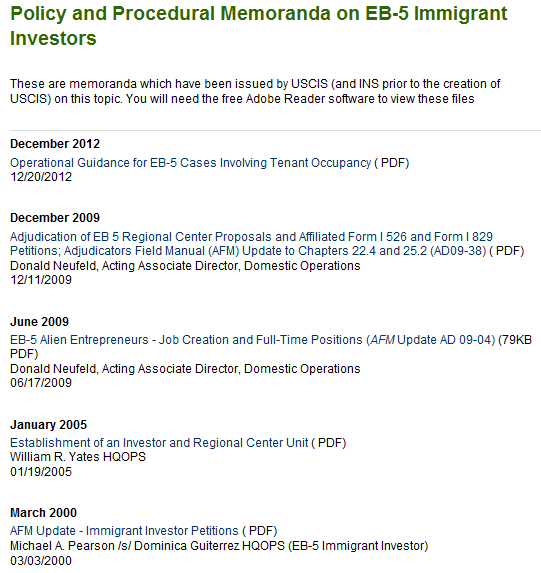
  • Kill or reincorporate the past.  The latest PM takes a wishy-washy approach in dealing with several prior policy utterances, listed below:

Picture
The PM states: "Prior policy guidance, to the extent it does not conflict with this PM, remains valid unless and until rescinded."  Why allow ambiguities to linger?  USCIS should rescind all prior guidance and incorporate all extant EB-5 policies in a single document as THE EB-5 Policy. Having taken the weasely approach of allowing prior non-conflicting EB-5 policies to survive, the new PM merely begs the question and allows agency adjudicators, regional centers, individual investors and their lawyers to argue over the "extent" to which prior policies have been superseded or supplanted.  Enough with the arguing.  Make it clear in one document.   

  • Republish the policy as a proposed or interim final rule in the Federal Register and allow notice and public comment.  The new PM says:
SCOPE: This PM is applicable to, and is binding on, all USCIS employees. * * *

VII. Use

This PM is intended solely for the training and guidance of USCIS personnel in performing their duties relative to the adjudication of applications and petitions. It is not intended to, does not, and may not be relied upon to create any right or benefit, substantive or procedural, enforceable at law or by any individual or other party in removal proceedings, in litigation with the United States, or in any other form or manner.

If USCIS were to pursue the admittedly slow procedure envisioned under the Administrative Procedure Act for publishing notice of a rule and the opportunity for the public to comment, none of the quoted verbiage, wiggle words no doubt drafted by the USCIS Office of Chief Counsel, would be necessary.  As welcome as the new PM is, and although it was preceded by a draft version on which the public was allowed to comment, USCIS never published the comments in the Federal Register (as would occur with a proposed or interim rule) and never explained why some comments were adopted and others eschewed.  Instead, the public and the courts are left to guess at whether the PM will actually be applied and be something on which the stakeholder community may rely.

  • Make sure economists are not EB-5 adjudicators.  Last week at a public forum, Director Mayorkas waxed lyrical over a supposed innovation he heralded. Henceforth, EB-5 adjudications would be made not by Immigration Officers but by newly hired economists who, he surmises, are better equipped by education to tackle the complex business and economic issues that arise in EB-5 petitions.  From now on, USCIS would no longer adopt the "hire to train" approach, whereby an indivdual is brought into the agency without experience and then trained in adjudicating a variety of immigration-benefits petitions and applications.  Rather, here on out in the EB-5 context, according to Director Mayorkas,  the agency will pursue a "hire to the skill" strategy, one that means that the successful job applicant at USCIS will only be hired if s/he already possesses the requisite skill -- an approach much like that of private industry. While the "hire to the skill" concept has much to commend it, the particular skill USCIS requires is not that of an economist.  No, the skill in question is possessed by those with a legal education.  At bottom, the EB-5 -- although containing elements of economic theory -- is ultimately a legal determination made by the application of facts to law.  USCIS should instead offer positions at a level of GS-13 and above to persons with at least a juris doctorate, preferably with bar admission and the ethical testing that entails.  This is not forging a new path; rather, it is merely replicating the reorganization of an adjudication function as occurred when the USCIS Asylum Office was reconstituted with lawyers in place of multi-function general adjudicators.  Economists can be advisors but should never be USCIS adjudicators.
  • Follow existing USCIS regulations in determining when a restructuring or reorganization creates a new EB-5 commercial enterprise. The EB-5 requires investment in a "new commercial enterprise" created, restructured or reorganized after the effective date of the law, November 29, 1990. On this point, the new PM states:
The immigrant investor can invest in an existing business, regardless of when that business was first created, provided that the existing business is simultaneously or subsequently restructured or reorganized such that a new commercial enterprise results. 8 C.F.R. § 204.6(h)(2). The facts of Matter of Soffici — where an investor purchased a Howard Johnson hotel and continued to run it as a Howard Johnson hotel— were not sufficient to establish a qualifying restructuring or reorganization. 22 I&N Dec. 158, 166 (Assoc. Comm’r 1998) (“A few cosmetic changes to the decor and a new marketing strategy for success do not constitute the kind of restructuring contemplated by the regulations, nor does a simple change in ownership.”). On the other hand, examples that could qualify as restructurings or reorganizations include a plan that converts a restaurant into a nightclub, or a plan that adds substantial crop production to an existing livestock farm.
The PM too narrowly defines a corporate restructuring or reorganization as only encompassing a change in the business model or plan. Instead, USCIS should adopt a customary corporate or tax law determination of when a reorganization or restructuring occurs as it did in its I-9 (employment-eligibility verification) rules at 8 C.F.R. § 274a.2(b)(1)(vii).  In that USCIS regulation an employer has the option of treating an individual as either a continuing or a newly hired employee if the worker "continues his or her employment with a related, successor, or reorganized employer" and the "employer . . . continues to employ some or all of a previous employer's workforce in cases involving a corporate reorganization, merger, or sale of stock or assets . . ."  Thus, whenever a predecessor entity undergoes a change involving a corporate reorganization, merger, or sale of stock or assets, then the successor entity thereby created should be treated at the employer's option as a new commercial entity for EB-5 purposes.  If the "simple change in ownership" dictum of the legacy agency in Matter of Soffici is to the contrary, then USCIS should overrule it.  Sauce for the goose is sauce for the gander.

  • No EB-5 adjudication without representation.  USCIS must allow every party in the EB-5 ecosystem with a valid legal interest to protect the right to counsel at no expense to the government in proceedings before the agency.  USCIS must not persist in perpetuating conflicts of interest (real or really possible) by barring the attorney for the regional center or the pooled-investment enterprise to advocate for the validity of his or her client's position when a foreign citizen submits a petition for EB-5 classification on Form I-526 or a petition for removal of conditions on Form I-829. Regional centers and pooled investment entities have their businesses and brands at stake with every I-526 and I-829 submitted, yet USCIS muzzles them and expects the investor-chosen lawyer to carry their water.  The SEC would never require businesses to risk their assets or reputations by relying on the investors' counsel to argue their interests.  Neither should USCIS.
  • No unsigned EB-5 adjudications.  The new PM goes a long way toward greater transparency, but not quite far enough.  The history of the EB-5 program has been pock-marked by policy reversals and arbitrary rulings.  One measure of transparency is accountability.  A decisionmaker becomes accountable when adjudicator puts on one's product his or her name (or nom de plum, in recognition of the need for personal and/or homeland security).  There must be a way for the government (outside of USCIS), the public and the EB-5 stakeholder community to hold accountable any adjudicator who repeatedly flouts USCIS's EB-5 policy.  If it worked for Voltaire (née François-Marie Arouet), it should also work for USCIS adjudicators.
  • It's time for Expedited Adjudication.  Quite a while back, USCIS indicated that it would adopt Premium Processing expedited service for at least some EB-5 adjudications. With the hiring rate still barely keeping up with population growth, the time for quick decisions across all categories of EB-5 petitions is NOW.
  • It's time for coupling. There is no reason why the new PM did not announce a benefit that is presaged in S. 744, the comprehensive immigration reform bill awaiting floor debate in the Senate.  That bill, as amended by a change Senator Leahy proposed, would allow foreign citizens who submit EB-5 petitions to file, concurrently, corresponding applications for adjustment of status to conditional permanent resident.  Concurrent petition and adjustment filing has long been allowed by USCIS -- without the need for enabling legislation -- in the first three employment-based green card categories. USCIS should extend the same privilege to EB-5 petitioners and their immediate family members.
* * *
The USCIS should be applauded for issuing a comprehensible and almost comprehensive PM.  The huzzahs will be louder still if and when it adopts additional measures, suggested above and by others, that would create conditions for the EB-5 program to blossom even more prodigiously in the years ahead.
0 Comments

Say What? Did BALCA Just Say That HealthAmerica Has Been Overruled?

6/4/2013

0 Comments

 
by Cora-Ann Pestaina, Associate with ABIL member, Cyrus D. Mehta
The Insightful Immigration Blog

I hang onto every word of the Board of Alien Labor Certification Appeals (BALCA). It’s the only way to make it through the preparation and filing of labor certification applications under Program Electronic Review Management (PERM) as not knowing what BALCA has said on a particular issue could be fatal to any PERM.  This recent statement by BALCA stopped me in my tracks for a moment.

In Matter of Sushi Shogun, 2011-PER-02677 (May 28, 2013), BALCA said, “HealthAmerica has effectively been overruled by the promulgation of 20 C.F.R §656.11(b).” Practitioners who file numerous PERM applications can empathize with my initial panicked gasp at seeing “HealthAmerica” and “overruled” in the same sentence.

As a background, over six years ago, BALCA issued HealthAmerica, 2006-PER-0001 (BALCA July 18, 2006). In this important en banc decision, BALCA held that the Certifying Officer (“CO”) should have reconsidered the denial of a PERM application where documentation held by the employer pursuant to the recordkeeping requirements of PERM conclusively established that the apparent violation was an unintentional typographical error on the ETA Form 9089. The Form 9089 contained an erroneous date indicating that the employer had placed a Monday ad instead of the required Sunday placement, when in fact the employer had acted to place the ad on Sunday and had the newspaper tear sheets of the advertisement to prove it. BALCA rejected the CO’s position that no new evidence could be submitted as the advertisement tear sheets were part of the PERM compliance recordkeeping requirement and thus was constructively submitted by the employer.

Since then, HealthAmerica has saved many PERM applications from certain doom and many employers from the Department of Labor’s (DOL) hyper-technical claws. BALCA even broadened HealthAmerica beyond typographical errors. In Matter of Pa’Lante, 2008 PER 00209 (May 7, 2009), the employer filed the ETA Form 9089 neglecting to list the alien’s experience gained before joining the employer and upon which he qualified for the offered position. But the alien’s substantial prior experience had been introduced in the employer’s response to the DOL’s audit notification through a September 2000 report of an Educational Consultant, who reviewed the alien’s education and experience credentials. The report clearly established that the alien had the requisite qualifications for the job well before he started work for the employer. BALCA reasoned that since the employer was able to introduce detailed evidence in its audit response and motion for reconsideration that was not fabricated or prepared after the filing, it would forgive the omission of experience and applied HealthAmerica.

After all this, does BALCA’s statement in Matter of Sushi Shogun now mean that employers can no longer cite HealthAmerica? In Matter of Sushi Shogun, the employer filed a PERM labor certification for the position of “Cook Assistant, Japanese Cuisine.” The application was audited and then denied because the ETA Form 9089 listed the prevailing wage as $10.04 per hour when the prevailing wage determination listed the prevailing wage as $10.14 per hour. The employer argued that this was a minor typographical error and a clerical mistake of minor importance; that the Notice of Filing listed the correct wage; that the offered wage was not listed in any advertisements or on the posting with the State Workforce Agency (SWA); and that no potential job applicant could possibly have been misled by the error. BALCA acknowledged that the error was likely just a result of someone mistyping the wage on the ETA Form 9089 and to deny the application essentially elevated form over substance (HealthAmerica at 19), but held that its hands were tied since the case was being considered after the promulgation of 20 C.F.R §656.11(b) which states that requests for modifications to an application will not be accepted for applications submitted after July 16, 2007. BALCA even went on to “reject the approach of the majority” in another case, Jesus Covenant Church, 2008-PER-200 (Sept. 14, 2009), in which case the employer listed a wage in the SWA job order that was the same as the prevailing wage determination, but 28 cents less than the wage offered to the alien.  The majority found that this was a harmless typographical error that did not lead to a conclusion that the job was not clearly open to any U.S. worker. In Matter of Sushi Shogun BALCA stated that it is “reluctant to second-guess the Secretary’s policy determination requiring applications filed after July 16, 2007, to be error-free.”

BALCA is taking a more firm stand in Matter of Sushi Shogun. But its holding can be limited to only preclude the use of HealthAmerica in situations involving a modification on the ETA Form 9089. This means that the employer in HealthAmerica and even in Pa’Lante whose harmless errors would essentially require a modification of the ETA Form 9089 would probably not be as successful in their appeals now. But HealthAmerica is still good law and can still be cited in cases where the denial of a PERM application is not consistent with notions of fundamental fairness and procedural due process; where the substantive integrity of the process was preserved; the test of the availability of US workers was valid; the Employer’s good faith is evident; the error is harmless; and does not require a modification of the ETA Form 9089.

HealthAmerica lives on by way of cases like Denzil Gunnels, 2010-PER-00628 (BALCA Nov. 16, 2010) and Federal Insurance Co., 2008-PER-00037 (Feb. 20, 2009). Under Denzil Gunnels (which Cyrus Mehta has blogged about here) if a PERM application is denied without an audit and the employer submits supplemental evidence that could be considered as part of the record under HealthAmerica, the CO should treat it as a request for reconsideration rather than a request for review. But, even in cases where the circumstances of a generic audit may not have been specific enough to put the employer on notice regarding a specific deficiency, the request for review should be treated as a request for reconsideration so that the employer has a fair opportunity to present supplemental evidence to the CO. For example, if the employer’s labor certification was denied because the DOL determined that a particular newspaper was not adequate, an employer could argue that the generic audit did not provide adequate notice of the deficiency and thus find its way around a strict application of the prohibition to present supplementary evidence that would otherwise be barred under 20 C.F.R. §656.24(g)(2)(ii). HealthAmerica via Denzil Gunnels can be influential in such a case which does not involve a modification of the ETA Form 9089.

In Federal Insurance Co., 2008-PER-00037 (Feb. 20, 2009), the fact that certain mandatory language pertaining to an alternative requirement under Matter of Francis Kellogg, 1994-INA-465 (Feb. 2, 1998) (en banc), did not appear on the ETA Form 9089 was not fatal as there is no space on the Form for such language. BALCA held that a denial in that instance would offend fundamental fairness and due process. A case with a similar type of issue, not involving a modification of the ETA Form 9089 can still be approved today despite BALCA’s grand statement in Matter of Sushi Shogun.

HealthAmerica is still alive and is still important to the preservation of the integrity of the PERM process in cases where there has been no demonstration of bad faith or after the fact fabrication and a modification of the ETA Form 9089 is not required.
0 Comments

No Longer Illegal, But Still An Alien

6/3/2013

0 Comments

 
Angelo Paparelli, ABIL Immediate Past President
Nation of Immigrators

[Blogger's Note:  Our guest blogger today is Careen Shannon, who is Of Counsel at Fragomen, Del Rey, Bernsen & Loewy, LLP and an Adjunct Professor of Law at the Benjamin N. Cardozo School of Law in New York. This is an updated and condensed version of an article Careen wrote for the online magazine Salon.com. Careen Shannon and Austin Fragomen blog about immigration issues at Fragomen on Immigration.]
No Longer Illegal, But Still An Alien
By Careen Shannon
Picture
When I lived in Japan in the early 1980s, they called me a gaijin: literally, an outside (gai) person (jin). While adults in the small town in which I initially resided generally satisfied themselves with staring at me wordlessly as I passed by, small children would often feign fear and yell “gaijin!” and then run away from me, screaming. I moved to Tokyo just when the film E.T. was released in Japan—which teenaged boys took as license to yell “E.T.!” when they saw me on the street. They tended to say it with a certain swaggering bravado, as if they were so above calling me gaijin like their country bumpkin cousins had done. But the implication in their clever pop culture association made my position in society clear, if it hadn’t been already: I wasn’t just a foreigner, an outsider. I was an alien. I might as well have been from outer space.

As Angelo has already reported here, and as I wrote recently in an article on Salon.com entitled “Stop Calling People Aliens,” the use of the word “illegal” to describe non-citizens who are present in the United States without authorization is finally beginning to die a well-deserved death, at least in the mainstream press. The announcement by the Associated Press in April that it would no longer use the word “illegal” to describe a person, only a status or an action, was quickly followed by a number of other major newspapers, including the New York Times, the Los Angeles Times and the Denver Post.

Despite this trend, the term “alien” remains not only in popular use, but also in the federal statute that regulates immigration to the United States, the Immigration and Nationality Act, which defines “alien” as “any person not a citizen or national of the United States.” The text of the comprehensive immigration reform bill recently approved by the Senate Judiciary Committee does nothing to upset this long-standing practice. Like the Japanese word gaijin, the word “alien” serves to exclude those upon whom it is bestowed. While it is true that Black’s Law Dictionary defines “alien” rather dispassionately as “[a] person who resides within the borders of a country but is not a citizen or subject of that country,” the colloquial use of the term is closer to its “regular” dictionary definition: “strange” or “repugnant” or “in science fiction, a being in or from outer space and not native to the Earth; extraterrestrial.”

Some may say that calling immigrants “aliens” doesn’t really matter, especially when the word is embodied in our law as a term of art. But I think it does matter, and I am not alone in this belief. When I was called “E.T.” in Japan many years ago, I could laugh it off because I knew that I would be returning to the United States once my graduate fellowship was complete. The epithet did not have any long-lasting impact on how I perceived myself as a human being. For immigrants to the United States, however, whether they are here without authorization or have immigrated through statutorily sanctioned channels, the lingering after-effects of the designation are undoubtedly harder to shake off.

As Professor Kevin R. Johnson, Dean of the University of California at Davis School of Law, has put it, “[t]he concept of the alien has … subtle social consequences…. [I]t helps to reinforce and strengthen nativist sentiment toward members of new immigrant groups, which in turn influences U.S. responses to immigration and human rights issues.” Keith Cunningham-Parmeter, an Associate Professor of Law at Willamette University College of Law, wrote a fascinating article for the Fordham Law Review in 2011 called “Alien Language: Immigration Metaphors and The Jurisprudence of Otherness.” In it, he applied research in cognitive linguistics to critically evaluate the metaphoric constructions of immigrants in U.S. law. He found that the three conceptual immigration metaphors that dominate legal texts--immigrants are aliens, immigration is a flood, and immigration is an invasion—influence not only judicial outcomes, but also social discourse and the broader debate over immigration reform.

A quick look at the history and etymology of the word “alien” in English is instructive. The word “alien” is thought to have entered the English language sometime between 1300 and 1350 from the Latin. The Latin word aliēnus derived from the earlier alius, meaning “other” or “else.” So an “alien” is, essentially, someone who comes from somewhere else. The Oxford English Dictionary (OED) cites the first legal usage as dating from 1522, in a law enacted under the reign of Henry VIII. Fast forward to early American jurisprudence, and the U.S. Constitution gives Congress the power “[t]o establish an uniform Rule of Naturalization.” The Naturalization Act of 1790—the first American law touching at all on the subject of immigration—provided the first such set of rules, allowing Congress to naturalize “any Alien being a free White person,” so long as such person met certain residence requirements, established that he or she was a person of good moral character, and took an oath or affirmation to support the Constitution of the United States. And thus was the word “alien” enshrined in U.S. immigration law.

What does outer space have to do with any of this? As it turns out, the use of the word “alien” to refer to creatures from outer space is much more recent than one might imagine. The earliest uses of “alien” as a noun to refer to extraterrestrials date from the early twentieth century. In 1935, Earl Binder wrote of a “Robot Alien” in the pulp science fiction magazine, Wonder Stories. In 1931, Nat Schachner & Arthur Leo Zagat wrote about “ten-foot tall aliens” in Venus Mines. And in 1912, Edgar Rice Burroughs (best known for his Tarzan stories) had a Martian character in A Princess of Mars call earthling John Carter “an alien.” This means that we had already been calling foreigners aliens for centuries before we started using the word to refer to extraterrestrials.

The surprising conclusion this leads to is that it’s not that we think foreigners resemble Martians, it’s that we think Martians resemble foreigners. Put another way: it is not the case that, the first time we saw a foreigner, he reminded us of an imaginary space creature. Rather, when we in the English-speaking world first conceived of the possibility (or at least first started writing about the notion) that there might be Martians (green skin and all that), the only image we could bring to mind was of a foreigner—and therefore the only word we could think of using was one that we already used to describe odd, strange, foreign beings. The fact that we appear to have named extraterrestrials after foreigners, rather than the other way around, reveals both the fear and the nativism at the heart of the immigration debate, and we ignore this at our peril.

Dismissing objections to calling immigrants “aliens” as political correctness run amok misses the point. The fact is that language has power. Changes in how language is used can lead to changes in how power is wielded. For example, nowadays, it is socially unacceptable for a white man to call a black man “boy,” but for years this was accepted practice in polite society—and, it is now commonly understood, not only reflected white society’s racism, but served to perpetuate the oppression of African-American men. Calling a grown woman a “girl” has a similarly belittling effect, and the fact that the practice has not yet been universally repudiated tells us something important about the continued inequality of women in American society.

As Professor Catherine MacKinnon of the University of Michigan Law School has written, “Social inequality is substantially created and enforced—that is, done—through words and images.” Referring to immigrants as “aliens,” when “alien” is commonly understood to be derogatory (whether because it means foreign, or strange, or brings images of extraterrestrial space creatures to mind), not only reflects immigrants’ place in American society, but in a very real way it enforces it. And be honest, now: which of the following is closer to what comes to mind when you hear the term “illegal alien” or “undocumented alien”—a German graduate student who has overstayed her visa, or a Mexican laborer who has illegally crossed our southern border? I think it’s a safe bet that, whatever your political persuasion, you were more likely to think of the Mexican.

In her seminal book, Language and Woman’s Place, linguist Robin Lakoff declared that “[l]inguistic imbalances are worthy of study because they bring into sharper focus real-world imbalances and inequities. They are clues that some external situation needs changing….” While she was specifically discussing terms she considered demeaning to women, her point is equally relevant to terms that are demeaning to immigrants. Lakoff has also said that “linguistic and social change go hand in hand: one cannot, purely by changing language use, change social status.” It is, however, sometimes difficult to tease out what is cause and what is effect. Does social change create language change, or does language change create social change?

My article in Salon generated a lot of comments, most of which were unpleasant and aggressive, to put it mildly. One person even went to the trouble to track down my email address, and sent me a lovely piece of hate mail. This all just proves the point that the term “alien” is loaded with prejudice. While changing the language won’t eliminate the prejudice, sometimes the best thing one can do is to shine a light on a problem. The responses to my article certainly indicate that I hit a nerve.

According to Lakoff, “[A]t best, language change influences changes in attitudes slowly and indirectly, and these changes in attitudes will not be reflected in social change unless society is receptive already.” As a member of a community of lawyers, scholars, advocates and others who work with, and care deeply about the plight of, immigrants in this country, I feel that we have a duty to do what we can to make society receptive already. So let’s stop calling non-citizens aliens. Let’s just call them people.

0 Comments
    Picture

    TO SUBSCRIBE

    Click the RSS Feed below

    RSS Feed

    ABIL

    The Alliance of Business Immigration Lawyers (ABIL) provides global reach and personal touch. We all value great legal ability and provide high standards of care and concern.

    Archives

    September 2018
    August 2018
    July 2018
    June 2018
    May 2018
    April 2018
    March 2018
    February 2018
    January 2018
    December 2017
    November 2017
    October 2017
    May 2017
    April 2017
    March 2017
    February 2017
    January 2017
    December 2016
    November 2016
    October 2016
    September 2016
    August 2016
    July 2016
    June 2016
    May 2016
    April 2016
    March 2016
    February 2016
    January 2016
    December 2015
    November 2015
    October 2015
    September 2015
    August 2015
    July 2015
    June 2015
    May 2015
    April 2015
    March 2015
    February 2015
    January 2015
    December 2014
    November 2014
    October 2014
    September 2014
    August 2014
    July 2014
    June 2014
    May 2014
    April 2014
    March 2014
    February 2014
    January 2014
    December 2013
    November 2013
    October 2013
    September 2013
    August 2013
    July 2013
    June 2013
    May 2013
    April 2013
    March 2013
    February 2013
    January 2013
    December 2012
    November 2012
    October 2012
    September 2012
    August 2012
    July 2012
    June 2012
    May 2012
    April 2012
    March 2012
    February 2012
    January 2012
    December 2011
    November 2011
    October 2011
    September 2011
    August 2011
    July 2011
    June 2011
    May 2011
    April 2011
    March 2011

    Categories

    All
    104(c)
    106(a)
    106(b)
    10-year Bar
    1252(a)(2)(D)
    12-Step Groups
    1967 Optional Protocol
    1 Year H-1B Extension
    2011 Immigration Awards
    2012 Elections
    2012 Immigration Awards
    2012 Immigration Year In Review
    2012 Nation Of Immigrators Awards
    2013
    2013; HB-87
    2013 In Immigration
    2014 Immigration Highlights
    2017
    204(j) Portability
    20 CFR § 656.12(b)
    20 CFR 656.17(f)
    212(a)(9)
    212(f) Of Immigration And Nationality Act
    212(i) Waiver
    212(k) Waiver
    245(i)
    274B
    287(g)
    3 And 10 Year Bars
    3 And 10 Year Bars.
    3d Printing Technology
    3 Year H-1B Extension
    458
    5 C.F.R. § 2635.402
    5th Circuit
    5 U.S.C. § 706(2)(A)
    5 U.S.C. § 706(2)(E)
    60 Day Grace Period
    79 Federal Register 79
    8 C.F.R. § 1003.10(b)
    8 USC § 1324b
    8 Usc 1621
    90 Day Misrepresentation
    9/11
    A-1 Diplomatic Visa
    AAO
    AB 103
    Ab 1159
    Ab 263
    AB 450
    ABA Model Rule 1.14
    ABA Model Rule 1.2(c)
    ABA Model Rule 1.2(d)
    ABA Model Rule 1.7(b)
    ABA Model Rule 3.3
    Abandonment
    Abolition Of 90 Day EAD Rule
    AC21
    AC 21
    Ac 21 + Status + H-1B
    Accountability
    ACLU
    Acus
    Additional Recruitment Steps
    Adjudicators
    "Adjustment Of Status"
    Adjustment Of Status
    Adjustment Of Status Portability
    Adjustment Portability
    "Administrative Appeals Office"
    Administrative Appeals Office
    Administrative Closure
    Administrative Conference Of The United States
    Administrative Fixes
    Administrative Law Judge
    Administrative Procedure Act
    Administrative Procedures Act
    Administrative Reform
    Administrative Review
    Administrative Review Board
    Admissibility
    Admissibility Review Office
    Admission
    Admissions
    Admitting To A Crime
    Adopted Decision
    Adoption
    Advance Parole
    Advertisement
    Advertisements
    Affidavit Of Support
    Affluent Foreigners
    Affordable Care Act
    Affording Congress An Opportunity To Address Family Separation
    AFL-CIO
    Agency Updates
    Aggravated Felon
    Aging Population
    AG Sessions
    Ahmed V. Gonzales
    AICTE
    Aila
    Airport Screenings
    Akayed Ullah
    Alabama Anti-Immigrant Law
    Alberto Gonzales
    ALCA
    Alejandro Mayorkas
    Alerts
    Alfredo Quinones-Hinojosa
    Alien
    Aliens
    Ali Mayorkas
    Alj
    All-India Council For Technical Education
    Ameircan Competitiveness In The 21st Century Act
    Amended H-1B Petition
    Amendment
    America
    America And Immigration
    America First
    America In Decline
    American Academy Of Religion V. Napolitano
    American Citizenship
    American Competitiveness In 21st Century Act
    American Council On International Personnel
    American Exceptionalism
    American Football
    American History
    American Immigration Lawyers Association
    American Kaleidoscope
    American Role
    Angelo A. Paparelli
    Ann Coulter
    Anonymity
    Anthony Kennedy
    Antidiscrimination
    Anti-immigrant
    Anti-immigration
    Anti-Immigration Legislation
    Anti-Immigration Movements
    Anti-Immigration Rhetoric
    Anti-Trump Protestors
    Ap
    APA
    APA Violation
    Appeals Administrative Office
    Appeasement
    Appellate Bodies
    Appellate Law
    Ap Stylebook
    Arbitrary Quotas
    Arden Leave
    Area Of Intended Employment
    Arizona
    Arizona Dream Act Coalition V. Brewer
    Arizona V. United States
    Arizona V. USA
    Aro
    Arpaio V. Obama
    Arrabally
    ART
    Artificial Reproductive Technology
    Assembly Bill 103
    Assembly Bill 263
    Assembly Bill 450
    Assisted Reproductive Technology
    Associated Press
    Asylum
    Asylum Claims
    ATLANTA
    ATLANTA IMMIGRATION LAWYER AT KUCK IMMIGRATION PARTNERS
    At Risk Investment
    Attorney Advertising
    Attorney Business Account
    Attorney Fees
    Attorney General
    Attorney General Javier Becerra
    Attorney General Jeff Sessions
    Attorney General Self-referral
    Attorney General Sessions
    Attorneys
    Attorney's Role
    Attorney Trust Account
    Attrition
    Audit
    Audits
    Auer V. Robbins
    August 18 Policy
    Australia
    Automatic Conversion Provision
    Automatic Extension EAD
    Avvo
    Avvo Legal Services
    Aziz V. Trump
    B-1
    B-1 In Lieu Of H-1B
    B-1 Visa
    B-1 Visas
    B-2
    B-2 Bridge
    Backlog
    Backlogged Countries
    Backlogs
    BAHA
    BALCA
    Bally Gaming
    Ban On Travellers
    Barack Obama
    Barring Entry To Protestors
    Bautista V. Attorney General
    Beltway Visa
    Beneficiary Pays Fees
    Benefit
    Benefits Of H-1B Visa
    Benefit The US Economy
    Best Practices
    Bilateral Investment Treaties
    Binational
    Biographies
    Biography
    Birthright Citizenship
    Blog Series
    Bloomberg
    Blueseed
    Bokhari V. Holder
    Bona Fide Marriage
    Bona Fide Termination
    Border Crossings
    Border Patrol
    Border Security
    Boston Marathon
    Boston Marathon Bombings
    Bradley
    Bradley V. Attorney General
    Brain Drain
    Brain Pickings
    Brains Act
    Brand X
    Brand X.
    Brazil
    Brazil Quality Stones Inc V. Chertoff
    Brent Renison
    Brexit
    Bridges V. Wixon
    Bridge The Gap
    British Riots
    Broader Definition Of Affiliation
    Broken Promises
    Brooklyn Law Incubator Policy Clinic
    Bseoima
    Bullying Words
    Business Necessity
    Business Visitors
    Business Visitor Visas
    Buy American Hire American
    California Attorney General Javier Becerra
    California Immigrant Worker Protection Act
    "California Immigration Law"
    California Immigration Law
    "California Immigration Laws"
    California Immigration Laws
    California’s Community Oriented Policing Services
    California Service Center
    Camo Technologies
    Canada Point Assessment
    Canadian Council For Refugees
    Cancellation Of Removal
    Candor To The Tribunal
    Candor To Tribunal
    Capitalist Ideals
    Careen Shannon
    Career Progression
    Carrp
    Case Completion Quotas
    CATA V. Solis
    Cato Institute
    Cato Institute Report
    CBP
    Ccg Metamedia
    Certification Of Questions Of State Law
    Cesar Chavez
    Chaidez V. United States
    Chaidez V. U.S.
    Chain Migration
    Chamber Of Commerce V. Whiting
    Change In Worksite
    Change Of Status
    Charles Garcia
    Charles Hossein Zenderoudi
    Charles Kuck
    Chemical Weapons
    Chennai
    Chevron
    Chevron Deference
    Child
    Children
    Child Status Protection Act
    Chile
    China
    Chinese Investors
    CHIP
    Chip Rogers
    Chobani
    Chris Crane
    Chuck Grassley
    Chuck Schumer
    Cimt
    Cir
    Cis
    Cis Ombudsman Second Annual Conference
    Citizenship
    Citizenship And Nationality
    Citizenship Application
    Citizenship Status
    Citizenship Status Discrimination
    Citizens United
    Ciudad Juarez
    Civil Disobedience
    Civil Gideon
    Civil Rights
    Civil Rights To All In New York
    Civil Surgeon
    CIWPA
    Client Site
    Client With Diminished Capacity
    Columbia
    Columbus Day
    Comment
    Common Law Definition Of Parent
    Communicable Disease
    Commuting Distance
    Companies Hosting Skilled Nonimmigrant Workers
    Compelling Circumstances EAD
    Competence
    Competitive Salary
    Comprehensive Immigratin Reform
    "comprehensive Immigration Reform"
    Comprehensive Immigration Reform
    Comprehensive Immigration Reform + Tyranny Of Priority Dates
    Computer Programmer
    Concurrent Cap Subject And Cap Exempt Employment
    Confidentiality
    Conflicts Of Interest
    Conflicts Of Law
    Congress
    Congressman Darrell Issa
    Congressman Gutierrez
    "Congress On Immigration"
    Congress On Immigration
    Conrad 30
    Conservatives; GOP
    Consolidated Appropriations Act Of 2016
    Conspiracy
    Constitutional Law
    Constitutional Requirement To Be President
    Constitution And The Presidency
    Construction Workers
    Constructive Knowledge
    Consular Absolutism
    Consular Nonreviewability
    Consular Non-reviewability Doctrine
    Consular Officer; Comprehensive Immigration Reform; Grounds Of Exclusion
    "Consular Officers"
    Consular Officers
    Consular Processing
    Consular Report Of Birth Abroad
    Consulting
    Consummation
    Continuous Residence
    Controlled Application Review And Resolution Program
    Controlled Substance
    Controlled Substances
    Corporate Counsel
    Corporations Are Not People
    Corporations Are People
    Court Ruling
    Courts On Immigration Law
    Covered Employer
    Crane V. Napolitano
    Creative Classes
    Credible Testimony
    Crime Against Humanity
    Crime Involving Moral Turpitude
    Crime Rate
    Crimes Against Humanity
    Crimes Involving Moral Turpitude
    Crime Without Punishment
    Criminal Alien
    Criminal Conduct
    Criminalize
    Criminal Liability
    Criminals
    Cross Chargeability
    CSPA
    Cuban Adjustment Act
    Culturally Unique
    Curricular Practical Training
    Customs And Border Protection
    Cutcherry
    Cut Off Dates
    Cyrus Cylinder
    Cyrus Mehta V. Tucker Carlson
    Cyrus Vance
    DACA
    DACA 2012
    DACA Driver's Licenses
    Daca Obama Deferred Action Immigration Reform9e741343b2
    Dan Kowalski
    DAPA
    Data Privacy
    David Foster Wallace
    Dead Us Citizen Petitioners
    Debate Questions
    December 2015 Visa Bulletin
    Declinist
    Deconflction
    Defense Of Marriage Act
    Deference
    Deferred Action
    Deferred Action For Childhood Arrivals
    Deferred Action For Parent Accountability Program
    Deferred Action For Parents
    Definition
    Definition Of Employment
    Delays
    Delta Information Systems V. USCIS
    Democrat
    Democratic Party
    Democrats
    "Democrats On Immigration"
    Democrats On Immigration
    Denial Of Immigration Benefit Application
    De Niz Robles V. Lynch
    "Department Of Homeland Security"
    Department Of Homeland Security
    Department Of Justice
    "Department Of Labor"
    Department Of Labor
    "Department Of State"
    Department Of State
    Depends On Experience
    Deportation
    Deportation President
    Deporter In Chief
    Deporterinchief84df2adda9
    Deporting Us Citizen Child Or Children
    Derivatives
    Detainers
    Deter
    De Tocqueville
    Dhanasar
    DHS
    Dhs New Rule On Hardship
    Dhs Office Of Inspector General
    Dhs Office Of Inspector General Report On Effects Of Adjudication Procedures And Policies On Fraud
    Dick Durbin
    Dickinson V. Zurko
    Dillingham Commission
    Diminished Capacity
    Din V. Kerry
    Director Mayorkas
    Discouraging Future Immigrant Crime Victims
    Discrepancies
    Discretion In Immigration Policy
    Discrimination
    Disney
    Disruption
    Disruption Of Continuity Of Residence
    Distinction
    Diversity Immigrants
    Diversity Visa Lottery
    DOL
    DOL Investigation
    DOL Prevailing Wage Guidance
    Doma
    Donald Trump
    Dream9
    "DREAM Act"
    Dream Act
    Dream Dream Actd977e910f6
    Dreamers
    Drivers License
    Driver's Licenses
    Drones
    Drop The Iword57cb7ffa6e
    Drug Cartels
    Drugs
    D/S
    Dsk
    Dual Citizenship
    Dual Dates
    Dual Intent Rule
    Dual Nationality
    Due Process
    Due Process Violation
    Duration Of Status
    Dusty Feet Court
    Duty Of Confidentiality
    Dv Lottery
    Dzhokhar Tsarnaev
    E-2
    EAD
    Early Adjustment Of Status Application
    Early Voting
    EB-1
    EB-2
    EB-3
    EB-3 India
    EB-3 To EB-2
    EB-5
    Eb-5
    EB-5 China Retrogression
    EB-5 Green Card
    EB-5 Independent Fiduciary
    EB-5 Insurance
    EB-5 Investor Visas
    EB-5 Letter Of Credit
    EB-5 Letters Of Credit
    EB-5 Policy Memorandum
    "EB-5 Program"
    EB-5 Program
    "EB-5 Regional Center"
    EB-5 Regional Center
    EB-5 Regional Centers
    "EB-5 Visa"
    EB-5 Visa
    EB-5 Waiting Line
    EB Backlogs
    Ebola
    Economic Policy Institute
    EDGE
    Edward Snowden
    Edwards V. California
    EEOC V. Arabian American Oil Co.
    Efstathiadis V. Holder
    Egregore
    El Badwari V. USA
    E L Doctorow35aebd6002
    Election 2012
    Elections
    Electronic I-9
    Eligible Immigration Statuses
    El Salvador
    Emma Willard School
    Employability
    Employed At Institution Of Higher Education
    Employee
    Employee Complaint
    Employee's Benefit
    Employer Business Expense
    Employer-Employee Relationship
    Employer-employee Relationship
    Employer-Employee Relationship For H-1B Visas
    Employer Sanctions
    Employment Authorization
    Employment Authorization Document
    Employment Based Document
    Employment-based Fifth Preference EB-5
    Employment-based First Preference EB-1
    Employment Based Immigration
    Employment-based Immigration
    Employment-Based Immigration
    Employment-based Preferences
    Employment-based Second Preference EB-2
    Employment-based Third Preference EB-3
    "Employment-Creation Immigrant Visas"
    Employment-Creation Immigrant Visas
    Employment Eligibility Verification
    Employment Training Administration
    Encourage Global Corporate Activities
    Enforcement
    Enforcement/USICE
    Entrepreneur
    Entrepreneurial Immigrants
    Entrepreneur Parole Rule
    Entrepreneur Pathways
    Entrepreneur Pathways Portal
    Entrepreneurs
    Entrepreneurs In Residence
    Entrepreneurs In Residence Initiative
    Entry Level Position
    Entry Level Wage
    Eoir
    Epithets
    Essential Function
    Esta
    Establishment Clause
    Esther Olavarria
    Eta
    Eta 9035
    ETA 9089
    ETA Form 9089
    Et Al. V. Her Majesty The Queen
    Ethical Considerations
    Ethics
    Ethics For Immigration Lawyers
    Everfyb99de80646
    E-Verify
    Everify Lock5c940d7f14
    E Visa
    E Visas For Entrepreneurs
    "Executive Action"
    Executive Action
    "executive Authority"
    Executive Authority
    Executive Branch
    Executive Office For Immigration Review
    "executive Order"
    Executive Order
    "Executive Orders"
    Executive Orders
    Executive Power
    Exempt Employee
    Exempt Investment Advisers
    Expanded DACA
    Expanded Definition Of Public Charge
    Expedited Removal
    Expert Immigration Attorney On The Case
    Expert Opinion
    Expert Opinions
    Experts
    Expiration
    Extended DACA
    Extension Of Status
    Extraordinary Ability
    Extraordinary Ability Aliens
    Extraordinary Achievement
    Extraterritoriality Of Immigration Law
    Extreme Hardship
    Extreme Vetting
    F
    F-1
    F-1 Visa
    Fair
    Fair Criminal Trial
    Fairness
    Fairness For High Skilled Immigrants Act
    False Stereotyping
    FAM
    Familybased Preferences9c4ff7f5f7
    Family First Preference
    Family Fourth Preference
    Family Immigration
    Family Offices
    Family Second Preference 2A And 2B
    Family Unity
    Fareed Zakaria
    Farm Workers
    Faustian Bargain
    FDNS
    Fdns Site Visit
    FDNS Site Visits
    Federal Immigration Court
    Federal Immigration Unions
    Federal Judge John A. Mendez
    Federal Judge John Mendez
    Federal Judge Mendez
    Federal Law
    Federal Preemption
    Fed. Reg. Vol. 80 No. 251
    Fee Splitting
    Fiance Visa
    Fifth Circuit
    Filibuster
    Filibuster Reform
    Filing Date
    Final Acceptance Date
    Final Action Date
    Final Guidance
    Final High Skilled Worker Rule
    Final Merits Determination
    First Amendment
    Flat Fees
    Flat Organizations
    Fleuti Doctrine
    Flores V. USCIS
    Fogo De Chao V. DHS
    Forced Migration
    Foreign Affairs Manual
    Foreign Chefs
    Foreign Cooks
    Foreign Earned Income Exclusion
    Foreign Employment Law
    Foreign Entrepreneur
    Foreign Language
    Foreign Law
    Foreign Migration Agent
    Foreign National Entrepreneurs
    Foreign Policy
    Foreign Specialty Chefs
    Foreign Specialty Cooks
    Foreign Students
    Foreign Support Personnel
    Foreign Trade
    Form 2555
    Form-i130
    Form I130862b02b70d
    Form I13169350c78aa
    Form I-485
    Form I601a86f76fbc24
    Form I-601A Waiver
    Form I765wsa6c10c7761
    Form-i800
    Form I821d14be16bf36
    Form I-864
    "Form I-9"
    Form I91b22a1589f
    Form I9242eea98cb70
    Form I942333509f53
    Form I94w5e6bfb52b7
    Form I-983
    Form I-983 Training Plan
    Form-i9-compliance
    Form I9 Employmenteligibility Verification7ddbfbc6b4
    Form-n400
    Fourth Amendment
    Fragomen On Immigration
    Fraud
    Fraud Detection And National Security
    Fraud Detection & National Security (FDNS)
    Fred 26 Imports
    Free Trade
    Function Manager
    Fusion
    Future Flows
    Future Immigration
    Future Of Preemption
    Future Position
    Fy14 H1b Visa Capcf6496c9e4
    Fy2014 H1b Filingsae2c14d3f1
    FY 2015
    FY 2018 H-1B Cap
    Gang Of 8
    Gang Of Eight
    Gang Violence
    Gender Bias
    Genocide
    Georgia
    Georgia Legislature
    Georgia Legislature Antiimmigration Legislation Everify8d746ab340
    Georgia Legislature; Immigration; Anti-Immigration Legislation; Immigration Reform
    Georgia Legistlature
    Georgia Restaurants
    Gideon V Wainwrightba979e7bac
    Giovanni Peri
    Gladysz V. Donovan
    Global Cities
    Global Detroit
    Global Entrepreneur In Residence
    Globalization
    Global Michigan
    Global Mobility
    Global Sourcing
    Global Trade
    Godot
    Golick
    Gonzales-Marquez V. Holder
    Good Faith
    Good Moral Character
    Good Old Days
    GOP
    "GOP On Immigration"
    Gop On Immigration
    Government Data Collection
    Government Employee Discipline
    Governor Brewer
    Grassley-Durbin Bill
    Greencard
    Green Card
    Green Card Lottery
    Green Cards
    Green Card Stories
    Grounds Of Inadmissibility
    Growing Up
    Guest Columns
    Guest Workers
    H-1B
    H-1b
    H-1B1 Visas
    H1b And L1 Visa Provisions984af42aac
    H-1B Auction
    H-1B Cap
    H-1B Cap Exempt Employer
    H-1B Cap Exemption
    H1b Cap H1b Visas Increased Visa Numbers1210555f7b
    H-1B Denial
    H-1B Denials
    H-1B Dependent Employer
    H-1B Entrerpreneur
    H-1B Extensions
    H-1B FY 2018 Cap
    H1b H1b Fraud Grassley Foia Training Memo Fdns Vibe Csce504cf6c27
    H-1B Lottery
    H-1B Lottery Illegal
    H-1B Portability
    H-1B Premium Processing
    H-1B Reform
    H1b Skilled Worker Dependent Employer7361d653a8
    H-1B Spouse
    H-1B Visa
    H-1B Visa Cap
    H-1B Visa Denials
    H-1B Visa Extension By Spouse
    H-1B Visa For Entrepreneurs
    "H-1B Visas"
    H-1B Visas
    H1b Visasfb0ea78c4c
    H1b Visas For Entrepreneurs And Owners3399e25691
    H-1B Wage
    H-1B Worksite
    H2b Visas79f843cb2c
    H-4
    H-4 And Work Authorization
    H56
    Hack
    Hague-adoption-convention
    Haiti
    Halt Act
    Hamilton Project
    Hana V Gonzales75adc25254
    Happy-lawyers
    Happy New Year
    Hardship Waivers
    Harry Reid
    Haruki Murakami
    Hateful Rhetoric Against Immigrants
    Hate Speech
    Hb 87
    HCL America
    Head Of State
    Healthamerica
    Helen Chavez
    Herman Cain
    Higher Wages
    High Skilled Worker Rule
    Hillary Clinton
    Hinojosa V. Horn
    Hispanic Immigrants
    Historic Exercise Of Discretion
    "homeland Security"
    Homeland Security
    Home Office
    Homosexual
    Honduras
    Hot Questions
    House Gop
    House On Immigration Reform
    Hr 3012
    Hr 3012c279c52631
    HR 4038
    Hr 4970
    Humane-treatment
    Humanitarian Parole
    Humetis
    Hurricane Sandy
    Hybrid
    I130-petition
    I130 Petition2b14f0b880
    I-140 EAD Rule
    I-140 Petition
    I-485 Supplement J
    I5268d5986011e
    I-539
    I601a46afd40326
    I601 Waiversa737e3d6da
    I-9
    I9-compliance
    I9 Compliance725c781af2
    I9 Compliance Checklist3909ef569e
    I9-errors
    I9-fines
    I9 Paperwork Violations24d1cb2cb9
    Ibrahim El- Salahi
    ICE
    ICE Arrests
    ICE Detainers
    ICE Notice Of Inspection
    ICE Notice Of Suspect Documents
    Ice Union
    Identity Theft
    IIRIRA
    Illegal
    Illegal Alien
    Illegal Aliens
    Illegal Conduct
    Illegal Immigrant
    Illegal Immigration
    Illegal Immigration; Immigration Reform; ESTA; Visas
    Illegals
    Immi Awards
    Immigrant
    Immigrant Achievement
    Immigrant Detention
    Immigrant Investor
    Immigrant Investor Program
    "Immigrant Investors"
    Immigrant Investors
    Immigrant Investor Visa
    Immigrant Rape Victims
    Immigrant Rights
    Immigrants
    Immigrant Visas
    Immigrant Worker Protection Act
    Immigration
    Immigration Abandonment
    Immigration Accountability
    Immigration Accountability Executive Actions
    Immigration Act Of 1990
    Immigration Adjudications
    Immigration Agencies
    Immigration Agency
    Immigration Agency Expertise
    Immigration-and-demography
    Immigration And Identity Theft
    Immigration And Nationality Act
    Immigration And Privacy
    Immigration And Terrorism
    Immigration And The Arts
    IMMIGRATION ATTORNEY
    Immigration Attorneys
    Immigration Auction
    Immigration Awards
    Immigration Benefits
    Immigration Bureaucracy
    Immigration Bureaucrats
    Immigration Cases
    Immigration Chain Of Command
    Immigration-compliance
    Immigration Court Backlog
    Immigration Courts
    Immigration Data Collection
    Immigration Decentralization
    Immigration Devolution
    Immigration Discretion
    Immigration Discrimination
    Immigration Enforcement
    Immigration Entrepreneurship
    Immigration Fantasies
    Immigration Forgiveness
    Immigration Forms
    Immigration Gamesmanship
    Immigration Gender Bias
    Immigration Inconsistency
    Immigration In Film
    Immigration Innovation Act Of 2015
    Immigration Inspections
    Immigration Inspectors
    Immigration Instructions
    Immigration Insubordination
    Immigration Interviews
    Immigration Intrigue
    Immigration Judges
    Immigration Judge Tabaddor
    Immigration Justice
    Immigration Justice System
    Immigration Language
    Immigration Law
    Immigration Law Absurdity
    Immigration Law Careers
    "Immigration Law Complexity"
    Immigration Law Complexity
    Immigration Law Extraterritoriality
    Immigration Law Humor
    Immigration Law Practice
    IMMIGRATION LAWYER
    Immigration Lawyer Atlanta Immigration Lawyer Immigration Reform Belief Believing704942b6fd
    Immigration Lawyers
    Immigration Legal Representation
    Immigration Legal Services
    Immigration Legal Services Delivery
    Immigration Lessons
    Immigration Memes
    Immigration Officers
    Immigration Officials
    Immigration On Tv
    Immigration Policies
    Immigration Policy
    Immigration Politics
    Immigration Portfolio Management
    Immigration Power
    Immigration Practice
    Immigration Profiling
    Immigration Protectionism
    Immigration Quotas
    "immigration Reform"
    Immigration Reform
    Immigration Reform Act Services
    Immigration Regulations
    Immigration Reporters
    Immigration Reporting
    Immigration Simplicity
    Immigration Status
    Immigration Terminology
    Immigration Themes
    Immigration Transition Team
    Immigration Transparency
    Immigration Truths
    Immigration Untruths
    Immigration Writing
    "Immigration Year In Review"
    Immigration Year In Review
    Immis
    Imperfect Immigration Past
    Impermissible Fee Splitting
    Improper Payments
    Imputed Intent
    INA 203(d)
    INA 203(h)(3)
    INA 204(j)
    INA 208(a)(2)(A)
    INA 212(f)
    INA 214(i)(1)
    INA 217(b)(12)
    INA § 240(b)(4)(B)
    INA 244(f)(4)
    INA 245(a)
    INA 245(k)
    INA 274(a)(1)(A)(iv)
    INA 274A(h)(3)
    INA § 274B
    INA 275
    INA § 301(g)
    Inadmissibility
    Ina Section 101a350fbc5520b3
    Ina Section 203d40da1fbde2
    Ina Section 204l15b30a9fb6
    INA Section 212(a)(2)(G)
    INA Section 301(g)
    INA Section 322
    Inc.
    Inclusive Speech
    INc. V. DHS
    Inc. V. USCIS
    Independent Contractor
    Independent Fiduciary
    India
    India And China
    India Inc.
    India IT
    Indian Citizens
    Indian IT Firms Or Companies
    Indian Prime Minister
    Indian Supreme Court
    Individualized Determinations
    Individual Shared Responsibility Provision
    Indonesian Christians
    Indophobia
    Ineffective-assistance-of-counsel
    Infected
    Infosys
    Infosys Immigration Settlement
    Infosys Settlement
    Infosys Visa Rules
    Inherent Skill
    Inhouse Counsel51701e4a40
    Innovation
    Insightful Immigration Blog
    Intending Immigrant
    Interior Immigration Enforcement
    International Criminal Court
    International Entrepreneur Parole
    International Entrepreneurs
    International Union Of Bricklayers And Allied Craftsmen V. Meese
    Internet Marriages
    Internment
    Interview
    Intracompany Transferee Visas
    Investigations
    Investment
    Investors
    Investor Visa
    Iran
    Iraq
    Iraqis
    Irca
    IRS
    Irs Form 2555
    Irs Publication 519
    I-Squared Act
    Italian Immigrants
    IT Consulting
    It Consulting Companies
    IWPA
    J1 Waiver3fd1477d5d
    J1 Waivers6f3dd388e8
    Jaen V. Sessions
    James McHenry
    Jan Brewer
    J And M Nonimmigrants
    Janet Napolitano
    Japanese American Internment
    Jared Kushner
    Javier Becerra
    Jeff Sessions
    Job Advertisements
    Job Creation
    Job Flexibility
    Job Portability
    Job Shops
    Joe Arpaio
    John A. Mendez
    John Doe Et Al. V. Canada
    John Mccain
    John Roberts
    Johnson V. United States
    John Yoo
    Joint-representation
    Jordan V. DeGeorge
    Jose Ines Garcia Zarate
    Josh Mckoon
    Journalism And Immigration
    Judge Hanen
    Judicial Deference
    Judicial Review
    Julia Preston
    July 1
    July 2007 Visa Bulletin
    Jus Soli
    Justice
    Justice Brandeis
    Justice Department
    Justice For Immigrants
    Justice Sotomayor Dissenting Opinion
    K-1 Visa
    K3 Visa37acf4a9cf
    Kansas
    Kate Steinle
    Kauffman Foundation
    Kazarian
    Kazarian V. USCIS
    Kellogg Language
    Kellogg Magic Language
    Kenneth Palinkas
    Kerry V. Din
    Khaled V Holder982a962865
    King V. Burwell
    Kleindienst V. Mandel
    Known Or Suspected Terrorist
    Know Nothing
    Kobach
    Korematsu V. United States
    Kovacs-v-united-states
    Kris Kobach
    Kris Koback
    Kst
    Kurupati V. USCIS
    L-1
    L-1A
    L-1A Visa
    L1a Visas537fc94d3f
    L-1B
    "L-1B Visa"
    L-1B Visa
    L1b Visaffc1d0a913
    "L-1B Visas"
    L1b Visas705e041a79
    L-1 Visa
    L1 Visa8e59dfe5b4
    L-1 Visa For Entrepreneurs
    L1-visa-intracompany-transferee-visa-intracompany-transfer-l1a
    L1 Visas291f967a4b
    Laboratories Of Democracy
    Labor Certification
    Labor Certification And Balca
    Labor Condition Application
    Labor Condition Applications
    "Labor Department"
    Labor Department
    Labor Market Testing
    Labor Shortages
    Labor Unions
    Lack Of Experience
    Lamar Smith
    Lameduck Congress2bd365b0dc
    Laos
    Lateef V Holder04525394c8
    Latino
    Law
    Lawfully Present
    Lawful Permanent Resident
    Lawful Permanent Resident Status
    Lawful Rejection
    Lawrence Fuchs
    Lawrence H Fuchs8538bb8495
    Lawsuit Against Daca
    Lawsuit Against Immigration Executive Actions
    Lawyers
    Lawyers Arguing
    Lawyers Debating
    Lawyer-suicide
    Layoffs
    LCA
    LCA Audit
    LCA/Labor Condition Application
    Leave Of Absence
    Ledbetter V. Goodyear Tire
    Legal Analysis
    Legal Ethics
    Legal Immigration
    Legalization
    Legal Limbo
    Legalnet
    Legal-status
    Legislative Updates
    Leon Rodriguez
    Less Flexibility
    Level 1 Or Entry Level Wage
    Level 1 Wage
    Level 1 Wages
    Lexmark Int’l Inc. V. Static Control Components Inc.
    Lexmark Int’l V. Static Control Components
    Lgbt
    Liberty
    Libya
    License
    Limited Representation
    Lindsey Graham
    List All Requirements
    Litigation
    Li V Renaudd8a40b72af
    Loan Model
    Loretta Lynch
    Loss Of Revenue
    Low Income Non-citizens
    Low Priority And Discretion
    Low Priority For Removal
    Lpr
    Lugo V. Holder
    Luis Gutierrez
    Lujan V. Defenders Of Wildlife
    Luna Torres V. Holder
    L Visa
    M274f95947aeb8
    Mad Men
    Maintenance Of Status
    Managerial Capacity
    Managerial Duties
    Mandamus Actions
    Mantena V. Johnson
    March 4
    Marco Rubio
    Maria Popova
    Marijuana Activities
    Mario Diazbalarta47ad78f9c
    Mario Rubio
    Marketbased Immigration Reformsac2c6c563f
    Marketing Fee
    Martinez-de Ryan V. Sessions
    Mary Yahya
    Massachusetts
    Master
    Matter New York State Department Of Transportation
    Matter Of AB
    Matter Of A-B
    Matter Of Acosta
    Matter Of Alyazji
    Matter Of ARCG
    Matter Of Arrabally And Yerrabelly
    Matter Of Avetisyan
    Matter Of B-C- Inc.
    Matter Of Cantu
    Matter Of Castro-Tum
    Matter Of Cognizant Technology Solutions
    Matter Of Credit Suisse Securities
    Matter Of Douglas
    Matter Of Ecosecurities
    Matter Of Emma Willard School
    Matter Of E.W. Rodriguez
    Matter Of Fpr515c6b2578
    Matter Of G- Inc.
    Matter Of G-J-S-USA Inc.
    Matter Of Hashmi
    Matter Of Hira
    Matter Of Horizon Computer Services
    Matter Of Izummi
    Matter Of J-R-R-A-
    Matter Of Karl Storz Endoscopyamerica6e946ac639
    Matter Of Koljenovic
    Matter Of L-A-B-R-
    Matter Of Lovo
    Matter Of M-A-M-
    Matter Of Marcal Neto
    Matter Of MEVG
    Matter Of Mississippi Phosphate
    Matter Of O. Vasquez
    Matter Of O Vazquez0fffb5957e
    Matter Of Rajah
    Matter Of Siemens Water Technologies Corp
    Matter Of Silva-Trevino
    Matter Of Simeio Solutions
    Matter Of Simelo Solutions
    Matter Of Skirball
    Matter Of Skirball Cultural Center
    Matter Of Symantec Corporation
    Matter Of The Clariden School
    Matter Of V-S-G- Inc.
    Matter Of WGR
    Matter Of Z-A-
    Matter Of Zamora
    Matter Of Zeleniak
    Matt Ramsey
    Mccain
    Medicaid
    Mehta Declaration
    Mehta V. DOL
    Meissner Memo
    Melania Trump
    Melissa Harrisperrye735025247
    Meme
    Memorandum Of Understanding
    Mental Competency
    Meritorious Claims
    Meritsbased Systemdcb9af44f1
    Mexico
    Michelle Malkin
    Michigan
    Micron Technologies
    Middle Vendor Arrangements And H-1B Visa
    Migrant Manifesto
    Military Families
    Military Service
    Minimum Requirements
    Misclassification
    Misinform
    Misprision-of-felony
    Miss Minnesota
    Mistakes By DSO
    Mitch Mcconnell
    Mitt Romney
    Modular Container Systems
    Moin V Ashcroft3374c3ffaa
    MOMA
    Moncrieffe V Holder2a74c71b8b
    Montana Campaign Finance Law
    #MoreThanALabel
    Morton June 17 Memo
    Morton Memo
    Morton Memo On Discretion
    Motion For Continuance
    Motion For Reconsideration
    Motions For Continuance
    Mou
    Msnbc
    Museum Of Modern Art
    Muslim Ban
    Muslim Travel Ban
    NAFTA
    Narendra Modi
    Narratives
    National Citizenship And Immigration Services Council
    National Day Of Action
    National Id Card
    National Immigration And Customs Enforcement Council
    National Interest Waiver
    National Interest Waivers For Entrepreneurs
    National Interest Wavier
    National Origin
    National Security
    National Security Concern
    Nation Of Immigrators Awards
    Nativism
    Nativist
    Naturalization
    Negotiable
    Neufeld Memo
    New I9268baceca5
    New International Legal Norm
    New Office L19f5f4f35f9
    New Rule Of Professional Conduct 7.2(b)
    Newspaper Of General Circulation
    News & Politics
    New State Ice Co V. Liebmann
    New Travel Ban Executive Order
    New York Constitutional Convention
    New York Daily News Op Ed
    New York State Bar Ethics Opinion 1116
    New York State Bar Opinion 1132
    New York Times
    Next Generation Tech Inc. V. Johnson
    Nexus Requirement
    Nfl
    Nguyen V. Holder
    Nicaragua
    Nicholas Colucci
    Ninth Circuit
    NIV
    NIW
    NOI
    NOIR
    Non-citizens
    Non-compete
    Non-existent USCIS Entrepreneurs Pathway Portal
    Nonfrivolous Application
    Nonimmigrant
    Nonimmigrant Visas
    Nonimmigrant Visa Status
    Non-justiciable
    Nonknown Or Suspected Terroristd52dcd7966
    Nonkst248c8faee5
    Nonprofit Affiliated Or Related To University
    Nonprofits And H-1B Cap
    Non-refoulement
    Non-work Activities
    Nostalgia
    Not Counting Derivative Family Members
    Not Counting Family Members
    Notice Of Intent To Revoke
    Notice Of Suspect Documents
    Notice To Appear
    November 2014 Midterm Elections
    NSD
    NSEERS
    NTA Policy
    Numbersusa
    NYSDOT
    O-1
    O-1 Visa
    Oath Of Allegiance
    Obama
    "Obama Administration"
    Obama Administration
    Obama Amensty Immigration Deferred Action81e6468f69
    Obama August 18 Announcement
    Obamacare
    Occupational Outlook Handbook
    Occupy Wall Street
    Ocrcl
    October 2012 Visa Bulletin
    October 2015 Visa Bulletin
    Offered Wage
    Office Of Civil Rights And Civil Liberties
    Office Of Foreign Labor Certification
    Office Of Inspector General
    Office Of Special Counsel
    Office Of Special Counsel For Unfair Immigration-Related Employment Practices
    Oig Report
    Olivia Sanson
    Omission
    One Labor Certification
    Opposition To Corruption
    OPT
    Optional Practical Training
    OPT Optional Practical Training
    Opt Out
    Opt Practical Training
    Osama Bin Laden
    Osc
    Oscar De La Hoya
    Osorio V Mayorkas806a9e9fb4
    Outrage
    Outsourcing
    Overqualification
    Overt Act
    O Visas
    O Visas For Entrepreneurs
    Ownership And Control
    P3 Visa72357cd170
    Padilla V Kentucky200410eaa5
    Paperwork Reduction Act
    Parole
    Parole For International Entrepreneurs
    Parole In Place
    Paroleinplace3a3ddef22b
    Particular Social Group
    Parviz Tanavoli
    Pat Buchanan
    Path To Citizenship
    Paul Ryan
    Peggy Noonan
    Penalties
    PERM
    Permanent Residency Options
    Perm-audit-triggers
    Perm-faqs-round-10
    PERM Labor Certification
    Person Of Extraordinary Ability
    Persons Of Extraordinary Ability
    Phantom Visa Status
    Physical Presence In A Foreign Country
    Piepowder Court
    Piers Morgan
    Pinochet
    Plain Language
    Plain Language Of Regulation Regarding Compelling Circumstances
    Plenary Power
    Plyler V. Doe
    Points System
    Policy
    Political Correctness
    Political Opinion
    Pope Francis
    Port
    Portability
    Portfolio Management
    Porting
    Porting Off Unadjudicated I-140
    Post Graduate Diploma
    Potential Court Challenge To Unlawful Presence Memo
    Potted Plants
    Preemption
    Premium Processing
    Premption
    Preponderance Of The Evidence
    Preponderence Of Evidence Standard
    President
    Presidential Debates
    Presidential Elections
    Presidentil Proclomoation 9645
    President Obama
    President Obama Executive Actions
    President Trump
    President Tump
    Presumption Of Fraud Or Misrepresentation
    Prevailing Wage Determination
    Prevailing Wage Determination Validity Period
    Primary And Alternate Requirements
    Printz V. United States
    Priority Date
    Priority Date Retrogression
    Priority Dates
    Private Employment Firms
    Pro Bono
    Pro-bono-legal-services
    Processing Times
    Procurement
    Prodsecutorial Discretion
    Prodsecutorial Discretion Morton Memo James Madison6c95a0548c
    Professional-responsibility
    Proper Signature
    Proposed Rule
    Prosecution For Illegal Entry
    Prosecutorial Discretion
    Protect And Grow American Jobs Act
    Protectionism
    Protests
    Provisional Waiver
    Provisional Waiver Of 3 And 10 Year Bars
    Proxy Marriage
    Public Charge
    Public Health Significance
    Public Service
    Puleo Memorandum
    Puppets
    P Visas
    Qiaowai
    Qualified Candidates
    Qualified Worker
    Quota
    Racial Profiling
    Racism
    Ragbir V. Homan
    Ragbir V. Sessions
    RAISE Act
    Ramirez V. Brown
    Ramirez V. Reich
    Rand Paul
    Range Of Experience
    Raud Detection And National Security
    Raul Hinjosaojedab7c338ba6c
    Ravi Ragbir
    Real Id Act
    Record Deportations
    Recruitment
    Recruitment Report
    Recusal
    Redcarpet Immigrationecf057f251
    Reentry Permit
    Reflecting On September 11
    Refoulement
    Refugee
    Refugee Convention
    Refugees
    Regional Center
    Regional-centers
    Regulations
    Regulatory Flexibility Act
    Regulatory Reform
    Reinterpretation
    Reinterpretation Of INA
    Religion
    Religious Freedom
    Religious Freedom Ground Of Inadmissibility
    Religious Workers
    Relinquish Us Citizenship25cc75ef5e
    Removal Orders And Work Authorization
    Removal Proceeding
    Removal Proceedings
    Render Unto Caesar
    Republican
    Republican Party
    Republicans
    Republicans On Immigration
    Requests For Additional Evidence
    Requests For Evidence
    Required Wage
    Rescission Of Deference Policy
    Residential Fiance Corp V. USCIS
    Resident Vs. Non-Resident Alien
    Restaurant Immigration
    Restrictive Covenant
    Resume Review
    Retention Of Priority Date
    Retroactive Application Of Agency Decision
    Retrogression
    Return Transportation Cost Or Payment
    Retweets
    Reverse Migration
    Revocation
    Revocation Of I130 Petition29e2465d50
    Reza Derakshani
    Rfe
    Rfes
    Rights Of Defendants
    Right To Counsel In Removal Proceedings
    Right To Protect
    Risking Lives
    Rnc Immigration Resolution
    Robert Bosch
    Robert Delahunty
    Robert Zimmerman
    Rod Serling
    Role Of Lawyers
    Romney
    Rosenberg V. Fleuti
    Roving Employee
    Roxana Bacon
    Ruben Navarette
    Rule 1648282cc144
    Rule 3369c1f5dca4
    Rulemaking
    Rule Of Law
    Rules
    Ruqiang Yu V Holder112d7eccb6
    Rusk V. Cort
    Russia
    Rust Belt
    Rust Belt Economies
    S 744388557e228
    Safe Third Country Agreement
    Salary
    Salas-v-sierra-chemical-co
    Same-or-similar
    Same Sex
    Same Sex Marriage
    Samesex Marriagea1a4c1687a
    Same Sex Relationships
    San-berardino-attacks
    Sanctuary
    Sanctuary Cities
    Sanders
    San Francisco
    San Francisco V. Trump
    Saturday Night Live
    Sayfullo Saipov
    Sb 1070
    Sb 170
    Sb 458
    SB 54
    Sb6
    SB 785
    Scales V. INS
    Scialabba-v-cuellar-de-osorio
    Scope Of Representation
    Scotus
    Second Amendment
    Second Circuit
    Second Class Citizenship
    Section-245i
    Section 377 Indian Penal Code
    Section-911
    Section-k
    Security Council
    Self Employment
    Self Referral
    Sen Al Franken8d17f34572
    Senate Bill 54
    Senate-homeland-security-and-governmental-affairs-committee
    Senate Immigration Reform Proposal
    Senate Judiciary Committee
    Senator Grassley
    Senator Hatch Legal Immigration Reform07d2d1ba79
    Senator Mccain
    Senator Rubio
    Senator Schumer
    Sen-coburn
    Sen Cornynb4913b20f7
    Sen Mccain70a20820e6
    Sen Reidd251095d63
    Sen Schumered4af5bde9
    Sen-tom-coburn
    Separating Children From Parents
    Separation Of Children
    Separation Of Powers
    September 11
    Sergio Garcia
    Sessions V. Dimaya
    Settlement Agreement
    SEVP
    Shabaj V Holdercba68a701d
    Shameful Adults
    Shortage Occupations
    Short-term Placement
    Show Me Your Papers
    Shyima Hall
    Siblings
    Simeio
    Simon Winchestor
    Singapore
    Singh V Reno628d251f29
    Site Visit
    Skidmore Deference
    Skilled Immigrants
    Skilled Legal Immigrants
    Skilled Workers
    Skype
    Slavery
    Smartzip
    Soccer
    Social Distinction
    Social Media
    Social Security Administration Ssa No Match Letterf1d55fcc30
    Sole-representation
    Solis-Espinoza V. Gonzales
    Somalia
    Sophie Cruz
    Sought To Acquire
    Sought To Acquire Lawful Permanent Residency
    Southern Border Enforcement
    Special Counsel
    Special Enrollment Period
    Special Immigrants
    "Specialized Knowledge"
    Specialized Knowledge
    Specialty Occupation
    Specialty Occupations
    Spouse Of H1b153354d1c2
    Staffing Companies
    Stakeholders
    Stalin
    Standard Occupational Classification
    Standing
    Startup
    Startup Visa
    Startup Visa31494d637e
    State Bar Of California
    "State Department"
    State Department
    State Department Advisory Opinion
    State Department Visa Bulletin
    State Enforcement Of Immigration Laws
    State Immigration Law
    State Immigration Laws
    State Law
    State Legislation
    State Rights V. Federal Preemption
    States
    States Refusal
    States Rights
    Status
    Status Violations
    STEM
    STEM 24-month OPT Extension
    Stem Green Card
    Stem Immigration
    Stem Jobs Act
    STEM OPT
    STEM OPT Employer Attestations
    STEM OPT Extension
    Step By Step Day Care LLC
    Stephen Miller
    Steve King
    St. Louis Ship
    Stories
    Storytelling
    Strauss Kahn
    Strausskahn00f7a82137
    Strausskahn0c784e0777
    Strickland-test
    Students And Scholars
    Stylebook
    Subcommittee On Immigration Policy And Enforcement
    Subhan V. Ashcroft
    Substantial Presence Test
    Success Stories
    Sudan
    Summary Removal
    Sunday Ads
    Super Fee
    Supervised Recruitment
    Supporting US High Skilled Business And Workers
    Supremacy Clause
    Supreme Court
    Supreme Court Of The United States
    Suresh Kumar Koushal V Naz Foundation0c35ab381e
    Surrogate Arrangements
    Surviving Spouse Immigration Benefits
    Suspension Of Premium Processing
    Suspension Of Prevailing Wage Determination
    Swde
    Syria
    Syrian Refugees
    Tabaddor V. Holder
    Take Care Clause
    Tamerlan Tsarnaev
    Tani Cantil-Sakauye
    Tapis International V. INS
    Taxes
    Tax Return
    Tax Treaty
    Teaching
    Techorbits
    Ted Cruz
    Ted Cruzs Canadian Citizenship97b85977cd
    Ted J Chiapparid1be1c2015
    Tek Services
    Telecommuting
    Temporary Labor Certification
    Temporary Nonimmigrant Waiver
    Temporary Protected Status
    Temporary Waiver
    Tenrec
    Tenrec Inc. V. USCIS
    Tenyear Bare5cfe49a0e
    Terminatiion
    Termination Of TPS
    Terrorism
    Tesla Motors
    Texas Anti-Sanctuary Law SB 4
    Texas V. United States
    Texas V. USA
    Thanksgiving Turkey
    That Was The Week That Was
    The Iword925fa53b25
    The Philippines
    The Snake
    The Tyranny Of Priority Dates
    Third Circuit
    Third Party
    Third-Party Arrangements
    Third Party Client
    Third Party Client Site
    Thomas Jefferson
    Threeyear Barca4ce1adbf
    Three Year Indian Degree
    Three Year Old
    Thrust Upon Conflicts
    Time
    Tina Turner
    TN Visas
    Tolling
    Tom Lehrer
    Top 10 Most Viewed Posts
    Torture
    Totality Of Circumstances Test
    TPP
    TPS
    Trade In Services
    Trade Policy
    Trade With India
    Trafficking
    Trafficking; VAWA
    Trafficking Victims Protection Reauthorization Act
    Training Plan
    Training Plans
    Transparency
    Travel
    Travel Authorization
    Travel Ban
    Travel Ban Executive Order
    Travel Ban Waivers
    Trayvon Martin
    Tribunal
    Truax V. Raich
    Trump
    Trump Immigration Policies
    Trump V. Hawaii
    Tseung Chu V. Cornell
    Turner V Rogerse0e2213e28
    TVRPA
    Tweets
    Twitter
    Two Priority Dates
    Tyranny Of Priority Dates
    "U"
    Unaccompanied Children
    Unaccompanied Minor
    Unaccompanied Minors
    Unauthorized Employment
    Unauthorized Immigrants
    Uncategorized
    Uncommon H-1B Occupations
    Unconstitutional
    Undamental Fairness
    Undocumented
    Undocumented Immigrant
    Undocumented Immigrants
    Undocumented Lawyer
    Undocumented Student
    Undocumented Workers
    Unhappy-lawyers
    United States Citizenship And Immigration Services
    United States Trade
    United States V. Bean
    United States V. Texas
    United States V Windsord2b852bf02
    United States V. Wong Kim Ark
    University Of Miami Law School
    Unlawfully Present
    Unlawful Presence
    U Nonimmigrant Visa
    Unsuccessful Prosecution
    USA V. California
    USA V. Olivar
    USA V. Texas
    US-Canada Border
    Us Chamber Of Commercea7b71cf5ba
    USCIS
    USCIS California Service Center
    USCIS Deference Policy
    USCIS Director
    USCIS Director Francis Cissna
    Uscis Economists
    USCIS Guidance
    Uscis Immigration Attorney Attorney At Immigration Interview Frauda4f5dad76b
    USCIS Listening Session
    "USCIS Ombudsman"
    Uscis Ombudsman
    "USCIS Policy Memorandum"
    Uscis Policy Memorandum
    U.S. Citizen Parent
    U.S. Citizenship
    Us Constitution
    Us Consulate
    Us Consulate081a8a95d6
    Us Consulates64f4af575b
    Us Customs And Border Protectione83df9ce06
    U S Immigration And Customs Enforcementca915606c7
    U.S. Immigration & Customs Enforcement
    Us Immigration Policy18cc81545d
    Us Tax Guide For Aliens
    Us V Arizonaa89601cba1
    U.S. V. California
    US Worker
    US Workers
    Us Workersbab035371d
    Utah
    U Visa
    U Visa Category
    U Visa Eligibility
    U Visa Status
    "U" Visa; U Visa
    Vartelas V Holdera1ea23ce84
    Vawa
    Velasquez-Garcia V.Holder
    Velasquez-Garcia V. Holder
    Vendor Management
    Vendor Relations
    Vera
    Vera V Attorney Generalaf3a90412f
    Vermont Service Center
    Viability
    Viability Of Fleuti
    Victims Of Abuse
    Victims Of Crime
    Victims Of Domestic Abuse Or Sex Crimes
    Victims Of Domestic Violence
    Villas At Parkside Partners V. Farmers Branch
    Vinayagam V. Cronous Solutions
    Violation Of Status
    Violence Against Women Act
    Vip Immigration
    Visa Application
    Visa Availability
    Visa Ban
    Visa Bulletin
    Visa Denials
    Visagate2015
    Visa Modernization
    Visa Revocation
    Visas
    Visa Voidance
    Visa Voidance 3year Bara99b8dc197
    Visa Waiver Admission
    Visa Waiver Program
    Vivek Wadhwa
    Vladimir Putin
    Void For Vagueness
    Voting
    Vwp
    Waiting In The Immigration Line
    Waiting Line
    Waiting List
    Waiver
    Waiver Of 10 Year Bar
    Waiver Of Inadmissibility
    Waivers
    Wall
    Washington Alliance Of Technology Workers
    Washington Alliance Of Technology Workers V. DHS
    Washington V. Trump
    WashTec
    Wealthy Travelers
    White House
    Work Authorization
    Work Permits
    Worksite
    Workspace
    Work Visas
    Worst Of The Worst
    Xenophobia
    Yemen
    Yerrabelly
    Youngstown Sheet & Tube Co. V. Sawyer
    Youseff V Renaud
    Youth
    Zombie Precedents
    Zone Of Interest
    Zone Of Interests

Powered by Create your own unique website with customizable templates.
Photo from Mrs Logic